
Secure SD-WAN That Builds on Your Existing Stack
Add to Your Network Without Disrupting It
Dispersive® Stealth Networking is a lightweight network overlay. There is nothing to rip out or redesign. It adds multipath resilience and quantum-resilient encryption for user, application, and AI agent traffic on top of the infrastructure in place today.
Use Every Available Path
Split traffic across the connections a site already has, with automatic path failover when one degrades.
Start With What You Have
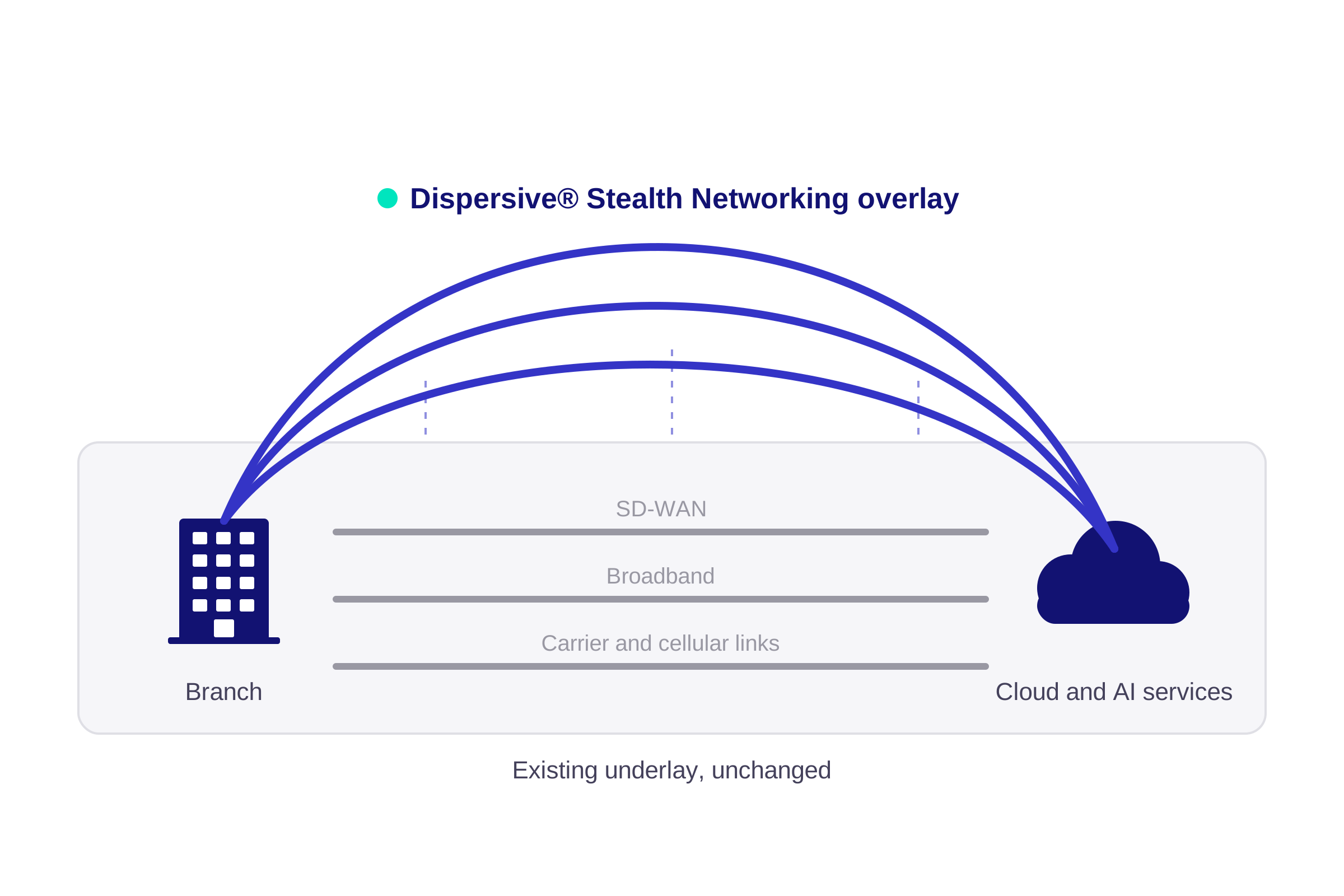
The overlay runs above existing SD-WAN and WAN infrastructure with nothing to rip out, and it can replace SD-WAN where that fits.
Secure Agent and Model Traffic
Agent, inference, and API communications travel encrypted across dynamic paths, on an overlay that evolves independently of the underlay.
The Branch Network Was Sized for People. AI Agents Change the Math.
The Challenge
Local Internet Breakout Puts Every User and Agent on One Route
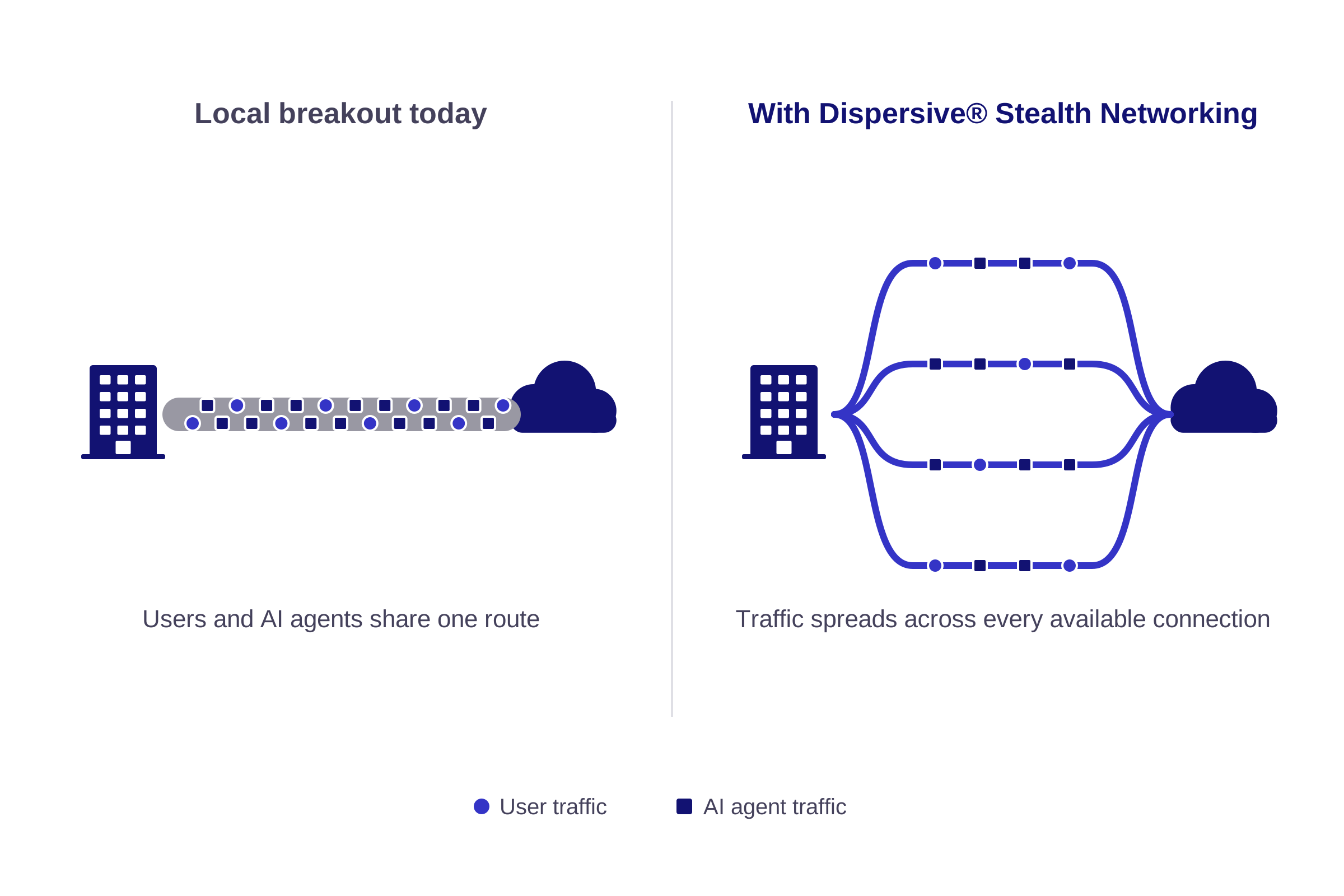
Branch networking has moved in steps. MPLS gave way to SD-WAN, and SD-WAN gave way to local internet breakout, where each site reaches cloud and SaaS services directly. Broadband now delivers 1, 2, even 5 Gbps at reasonable cost, so the capacity problem looks solved. It isn’t. Local breakout still sends a site’s traffic out through one shared route to the internet. More bandwidth widens that highway. It doesn’t add a second one.
Agentic AI changes what travels on that highway. Branch networks were sized around users, devices, and applications, but a 1,000-person branch is no longer 1,000 network consumers. Each employee may work with several AI agents, and each agent calls models, APIs, data sources, and other agents on its own. Network demand no longer tracks headcount.
The result shows up at the help desk. Agent traffic competes with the people trying to work, and calls and applications start to drop, lag, or freeze. When a user reports a problem, the path that is struggling is often the same path the operations team needs to reach the site and diagnose it.
The Dispersive Solution
Put Every Branch Connection to Work
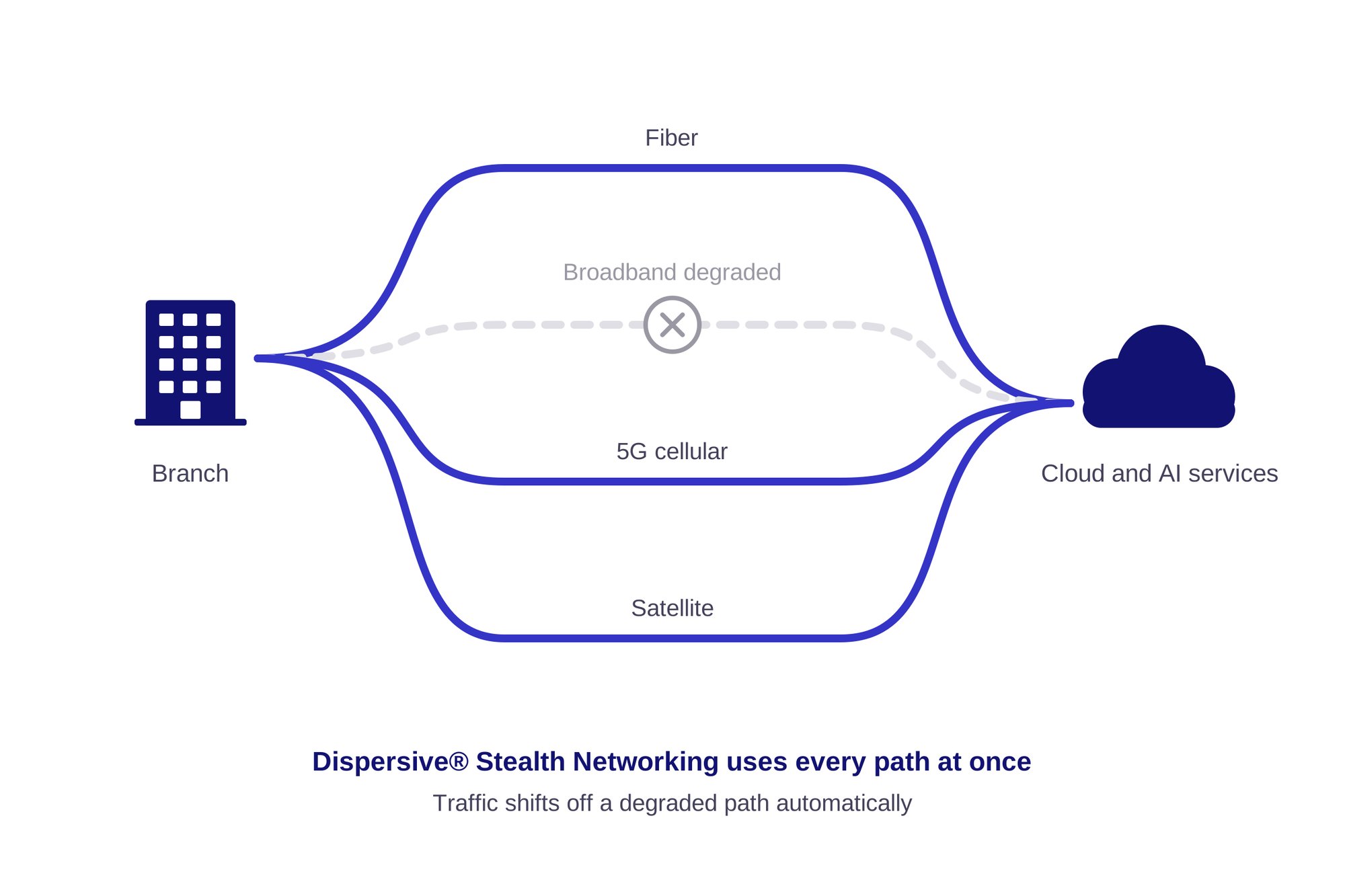
Dispersive® Stealth Networking adds a lightweight overlay at the branch that uses every connection the site already has at the same time: fiber, broadband, 5G, satellite, and existing SD-WAN links. User and agent traffic spreads across all of them instead of sharing one route, and automatic path failover moves traffic off any path that degrades.
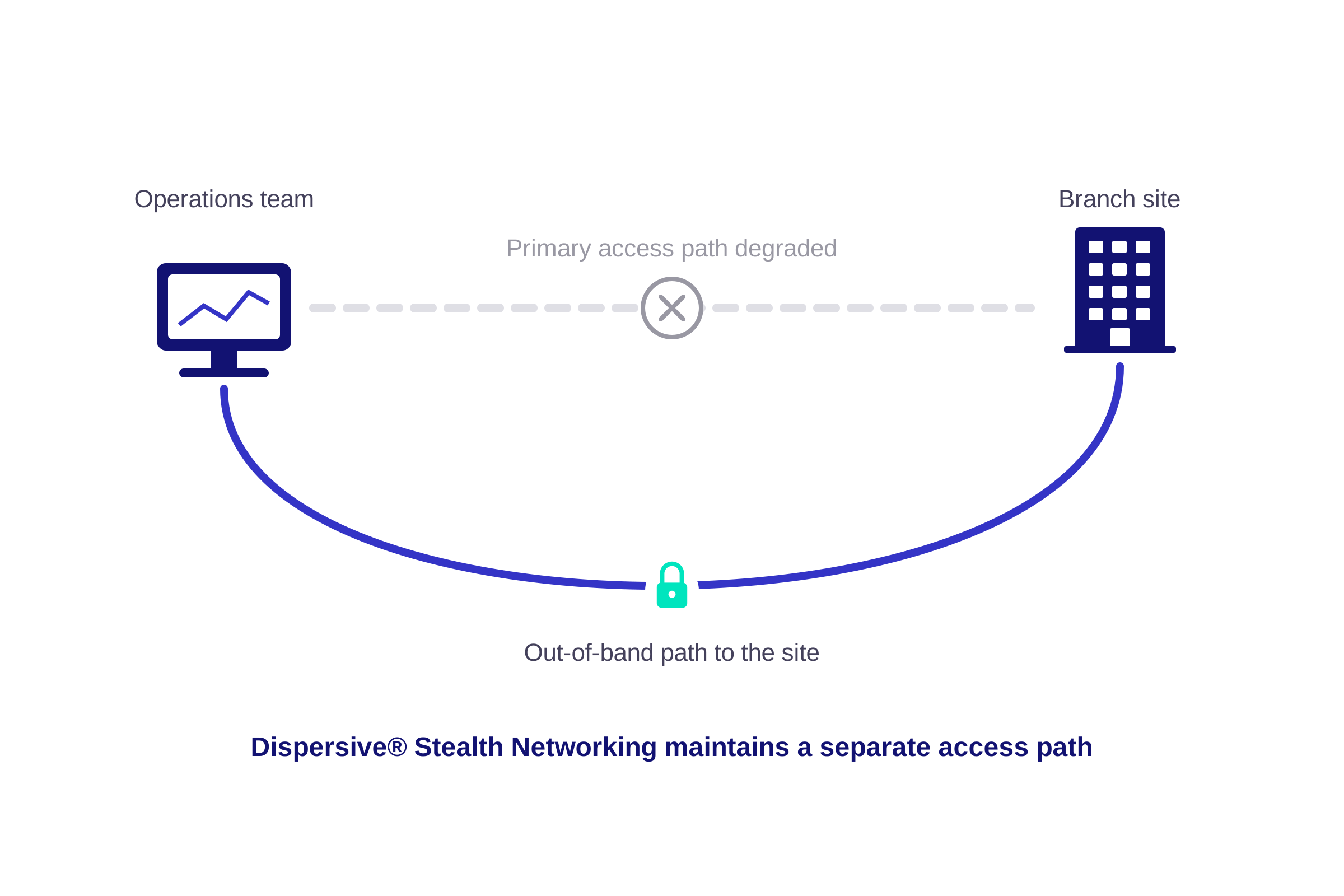
The overlay also keeps a separate, out-of-band path into the site. When a user calls the help desk, the operations team can still reach the branch to diagnose the problem. Nothing underneath changes: the SD-WAN, the carriers, and local breakout all stay in place.
Inside the Dispersive Overlay
Multipath Across Every Available Connection
Dispersive splits traffic across multiple paths at once, using the connections a site already has: fiber, broadband, 5G and other cellular links, satellite, and existing SD-WAN links. Paths change dynamically, and automatic path failover moves traffic off a degraded path so the session continues. A second connection stops sitting idle as a backup and starts carrying traffic.
Above the Underlay, Independent of It
Dispersive runs over any IP connectivity and doesn’t depend on a single carrier or access method. Network teams keep their SD-WAN policies, routing, and carrier contracts. The overlay adds a layer above them, so new requirements no longer wait on a WAN redesign.
Built for Agent and Model Traffic
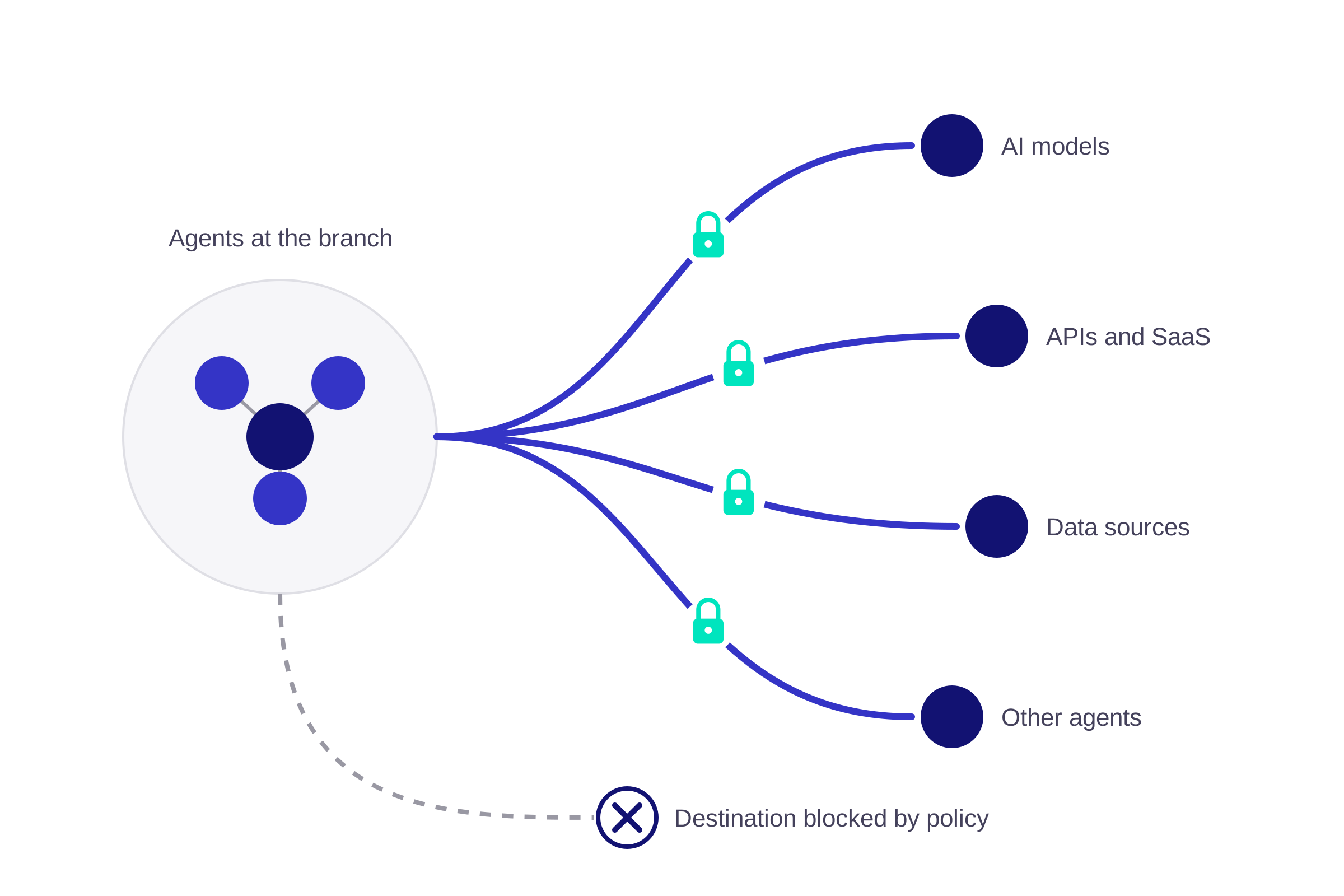
AI agents communicate machine to machine with inference services, APIs, and other agents. Dispersive carries those communications on an encrypted overlay and enforces URL filtering at the network layer, so policy can limit which destinations an agent, user, or application can reach.
Quantum-Resilient by Design
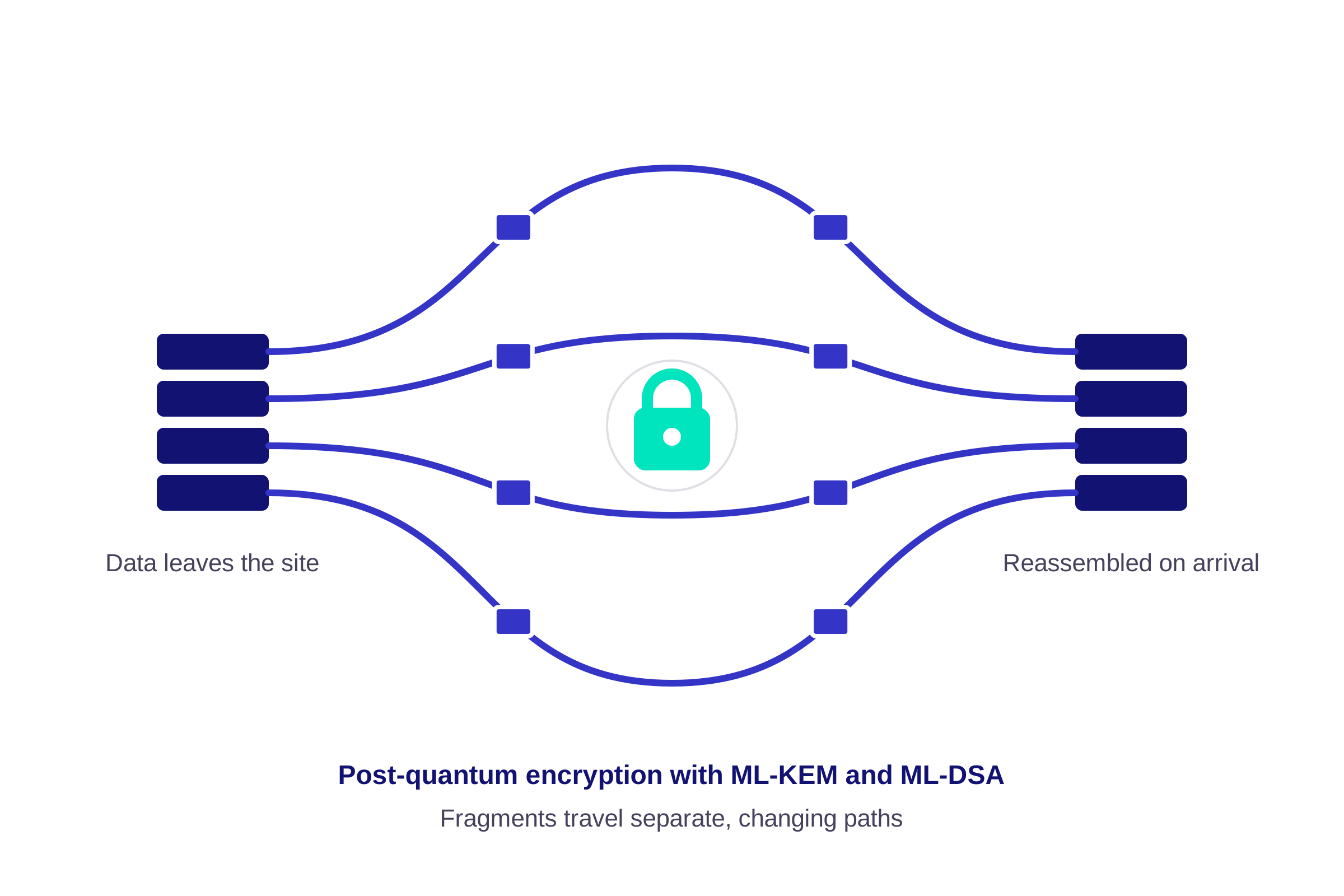
Dispersive applies post-quantum cryptography using NIST-standardized ML-KEM and ML-DSA across both the data plane and control plane, and the cryptographic module powering Dispersive services is FIPS 140-3 validated. Crypto agility lets algorithms change in one place rather than across every appliance and endpoint. Splitting traffic across dynamic paths also reduces exposure to harvest-now, decrypt-later collection.
Out-of-Band Access When the Primary Path Fails
Troubleshooting is hardest when the impaired path is the only way into the site. Dispersive maintains a separate, out-of-band path to the branch, so operations teams and their own tools can reach the environment while production traffic is degraded. Ovzon uses it as break-glass access into its sites that doesn’t depend on its normal access mechanisms.
FAQs
It can, but it doesn’t have to. Dispersive is a lightweight network overlay that runs above existing SD-WAN, broadband, and WAN infrastructure, so most organizations add it and keep what works. Organizations that want to retire their SD-WAN can also run Dispersive in its place, using its multipath routing and automatic path failover across the same connections.
An SD-WAN overlay is a network layer that runs on top of an existing SD-WAN and its underlying connections. Dispersive is a secure SD-WAN overlay. It splits traffic across multiple paths, encrypts it with post-quantum cryptography, and applies network-layer policy without changing the SD-WAN underneath.
Dispersive splits each session across multiple dynamic paths, so no single path carries a complete, predictable stream. Traffic is encrypted with NIST-standardized post-quantum algorithms, and network-layer URL filtering controls which destinations users, applications, and agents can reach. Dispersive operates after authentication and extends zero trust rather than replacing it.
Branch networks were sized around users, devices, and applications. AI agents add machine-generated traffic: each agent may call models, APIs, data sources, and other agents on behalf of one employee. Network demand stops tracking headcount, and human and agent traffic compete for the same connections.
Not on its own. More bandwidth widens a single route, but traffic still depends on that route. Dispersive uses the multiple connections a site already has at the same time and reduces dependence on any one path. It doesn’t create bandwidth that isn’t there; it puts every available path to work.
Yes. Dispersive runs over the same broadband and internet connections used for local breakout. It adds multipath resilience and encryption to traffic leaving the branch without changing how the site reaches cloud and SaaS services.
Yes. Dispersive applies post-quantum cryptography using NIST-standardized ML-KEM and ML-DSA across the data plane and control plane, and the cryptographic module powering Dispersive services is FIPS 140-3 validated. Crypto agility lets algorithms change in one place. Organizations still need to remediate quantum-vulnerable cryptography in applications and endpoints for full coverage.
Dispersive offers two deployment models. DispersiveCloud® is a hosted SaaS deployment, and DispersiveFabric™ is self-hosted on the infrastructure you choose. Either way, you control how it runs: Dispersive can host and operate the control plane, or you can host it and control every component.
Two Ways to Deploy Dispersive® Stealth Networking
Fortifying Networks with Secure, Resilient, and High-Performance Connectivity
DispersiveCloud®
DispersiveCloud® is a hosted SaaS deployment, SOC 2 Type II certified, that simplifies deployment and management without compromising performance or security. It runs on global cloud infrastructure from providers including Amazon Web Services and Azure for high availability.
DispersiveFabric™
DispersiveFabric™ is the self-hosted deployment, built for larger, more complex environments, where you run and control every component. A software-defined overlay network with a microservices architecture, DispersiveFabric™ deploys on the infrastructure you choose; public cloud, private cloud, containers, VMs, or dedicated hardware.
How Does a Network Overlay Work with SD-WAN?
A network overlay is a virtual network that runs on top of existing physical connections and carries traffic across them without changing the underlying infrastructure. Dispersive is a secure network overlay built on stealth networking. It adds multipath resilience, encryption, and policy above whatever WAN a site already runs.
SD-WAN manages the WAN: it steers traffic across available transports, applies routing and application policies, and connects branches to cloud and data center resources. Dispersive operates above that layer. It takes the paths SD-WAN and the carriers provide and makes the traffic on them harder to find, harder to break, and quantum-resilient.
So the question isn’t “SD-WAN or Dispersive?” It’s what a network needs above the WAN to support distributed applications and AI agents. In some environments, Dispersive can also take over SD-WAN or VPN functions. Most organizations start by adding the overlay and keeping the infrastructure that works.
Keep the Infrastructure That Works. Add the Layer That Comes Next.
Enterprise WAN infrastructure changes slowly. AI demand doesn’t. Dispersive lets the two move on separate timelines by adding secure multipath connectivity above the SD-WAN and broadband you already run. Start with a Technical Proof of Value at one site.
