
Mission Assurance Through Adaptive Communications

For federal and defense organizations, communications infrastructure has become part of the operational environment itself. Dispersive® Stealth Networking is built on the assumption that adversaries are already positioned inside infrastructure. Public reporting on campaigns like Salt Typhoon and Volt Typhoon confirms they are both present and well established.

By segmenting and encrypting communications across multiple independent paths, Dispersive makes sure no single point of compromise ever reveals a complete picture, so the mission keeps moving even when the network can't be trusted. Dispersive keeps mission applications running through degraded, denied, and contested conditions. The result is a software-defined transport fabric that combatant commands, mission partners, and federal systems integrators can field on mission-approved or customer-furnished hardware, with no rip-and-replace required.

Infrastructure-Centric Cyber Defense

Multipath obfuscation and moving target defense fragment and encrypt traffic across independent paths, denying adversaries the complete session visibility that makes infrastructure compromise valuable.

Communications Continuity

Dynamic, real-time path selection across fiber, cellular, satellite, and other transports sustains mission applications through disconnected, denied, intermittent, and limited-bandwidth (DDIL) conditions.

Infrastructure Independence

A software-only gateway deploys on mission-approved or customer-furnished hardware, supporting data sovereignty and multi-cloud, multi-domain operations without proprietary appliance dependencies.

Five Mission-Ready Solution Areas

Dispersive's adaptive communications architecture is fielded across five mission areas, each solving a distinct operational challenge:

Mission Partner Enablement — rapid, ephemeral coalition and mission-partner connections with fast provisioning and equally fast revocation.

OSINT & Intelligence Operationsstealth and obfuscation properties that protect open-source intelligence collection and analysis infrastructure.

Tactical Edge & Resilient Communications — assured, resilient edge-to-cloud and edge-to-edge communications for contested and DDIL environments.

Gray Cloud Services — sovereignty and stealth transport layered onto gray-cloud infrastructure for sensitive federal missions.

Critical Infrastructure & OT Protection — moving target defense and multipath obfuscation addressing the availability and legacy-system constraints of OT environments.
Five Mission-Ready Solution Areas

Dispersive Mission Outcomes

Mission Assurance

Dispersive is built for information that has to stay confidential for decades, not days. Because Dispersive splits communications into independently encrypted segments distributed across different paths, an adversary who eventually breaks the encryption on one segment still has to correctly reconstruct timing relationships across every other segment before decryption produces anything readable — turning Harvest-Now-Decrypt-Later into Harvest-Now-Reconstruct-Later.
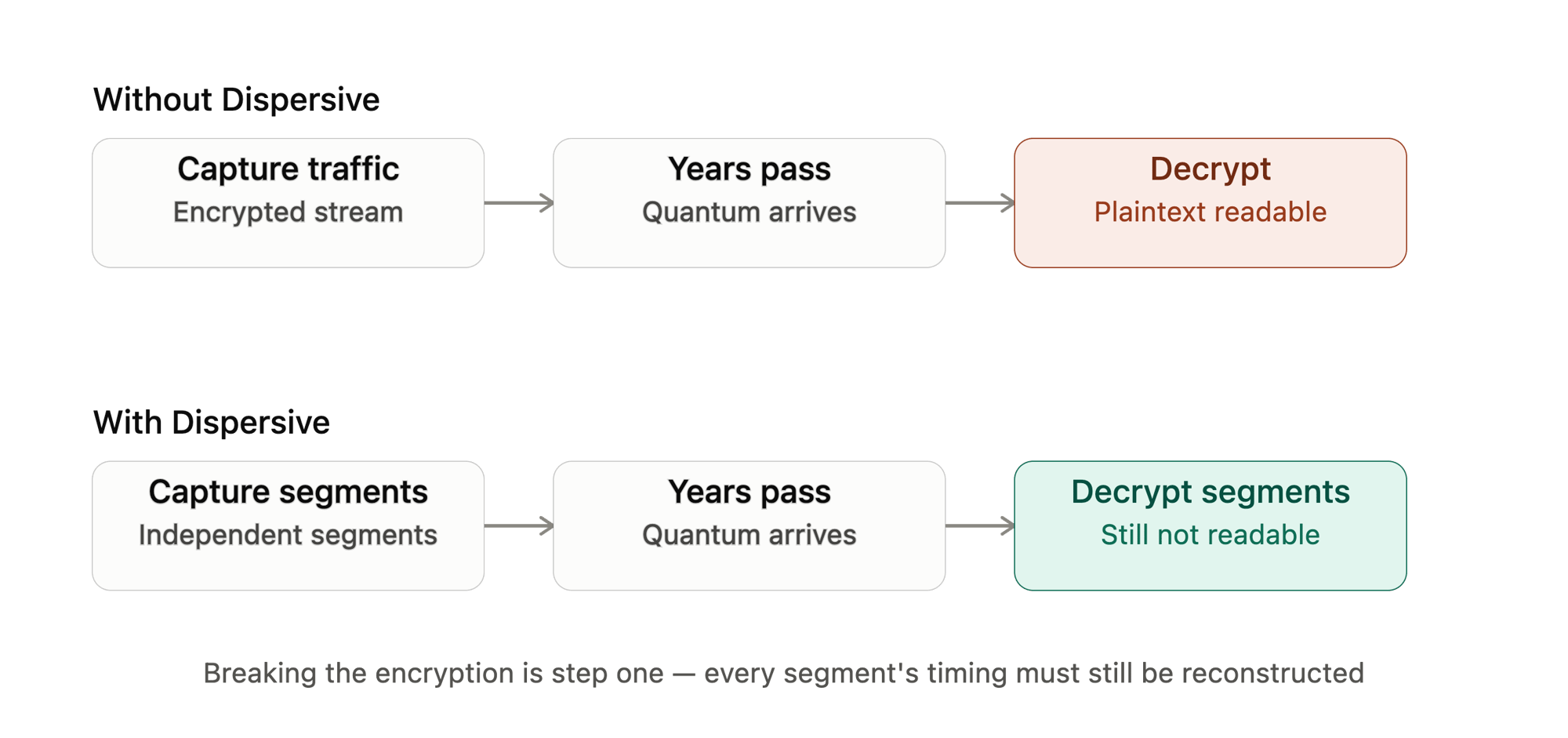
Harvest now reconstruct later diagram
Operational Continuity

A conventional VPN or SD-WAN session is disrupted when its active path degrades or fails. Dispersive uses multiple independent paths simultaneously and adapts in real time, automating primary, alternate, contingency, and emergency (PACE) transitions across radios, SATCOM, and terrestrial links so operators aren't manually failing over mid-mission.
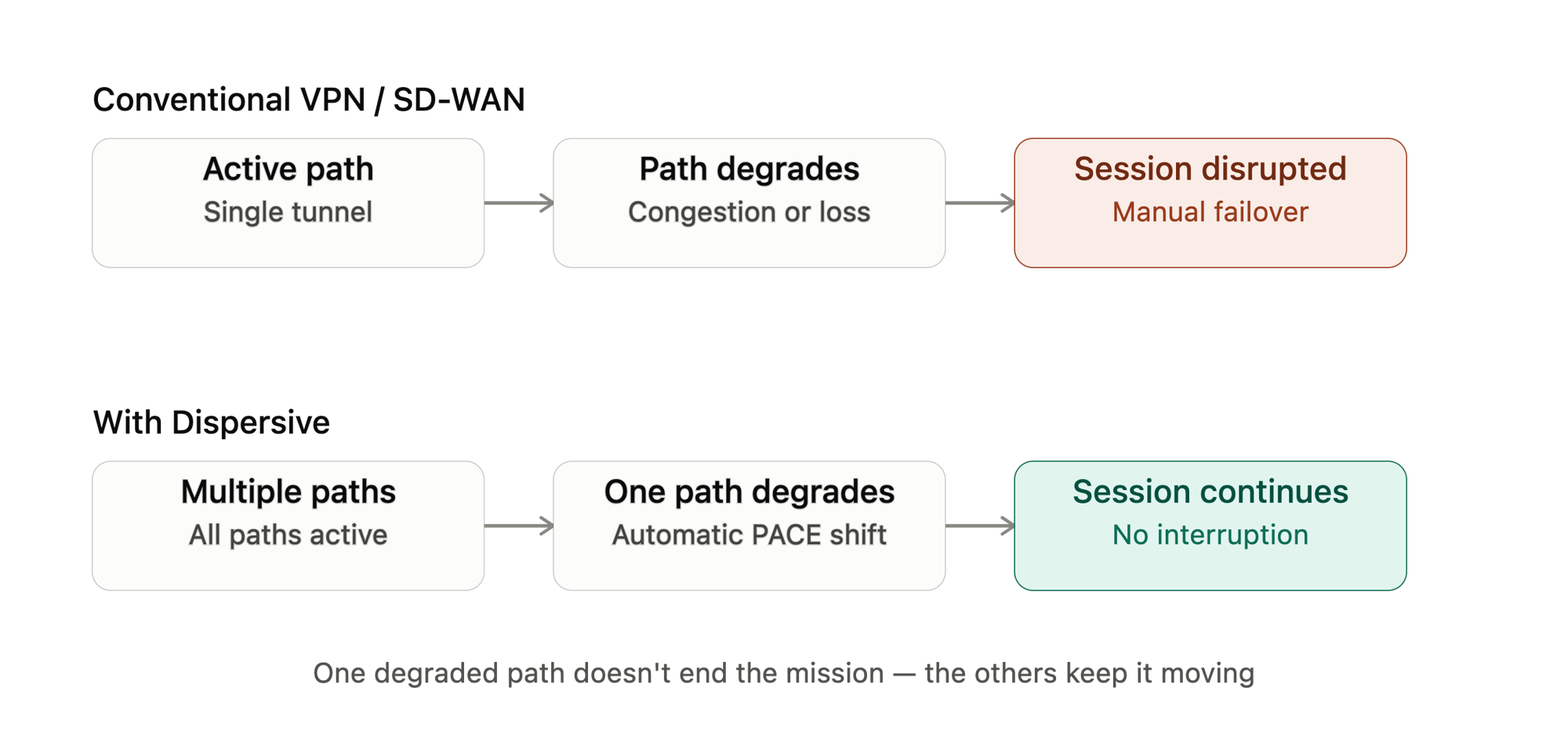
Diagram of operational continuity
Decision Advantage

First-strike planning depends on a mapped, predictable communications topology. Dispersive denies that map: an adversary with administrator access to a single carrier or router still only recovers the segments that traversed that specific device, not the complete session — multiplying the number of independent compromises required to reconstruct anything useful.
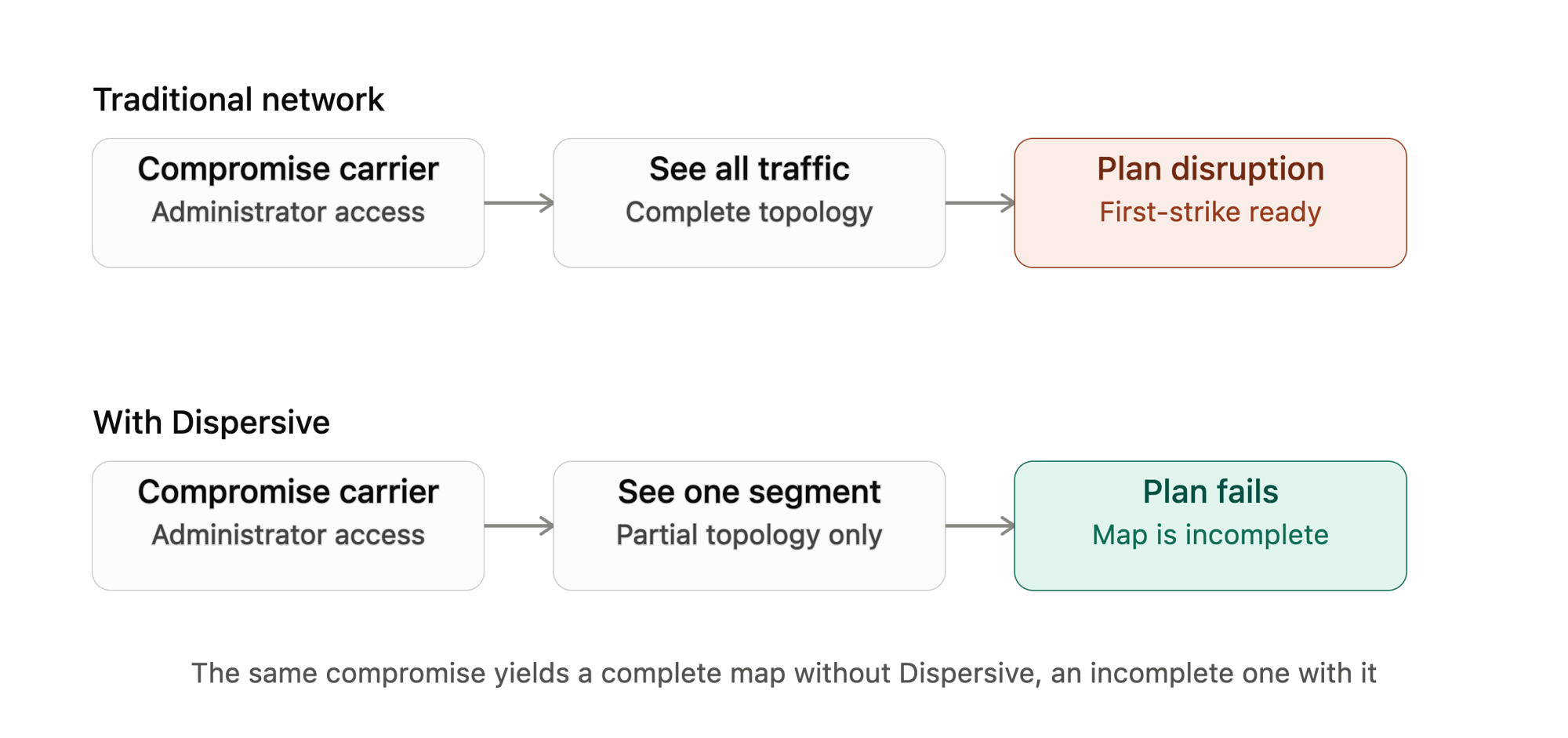
decision advantage topology
Operational Agility

Dispersive deploys as a software-only gateway on mission-approved or customer-furnished hardware, including COTS devices such as a Raspberry Pi, so integrators can add resilient, low-observable transport to an existing program without a rip-and-replace architecture or new proprietary appliances to support logistically.
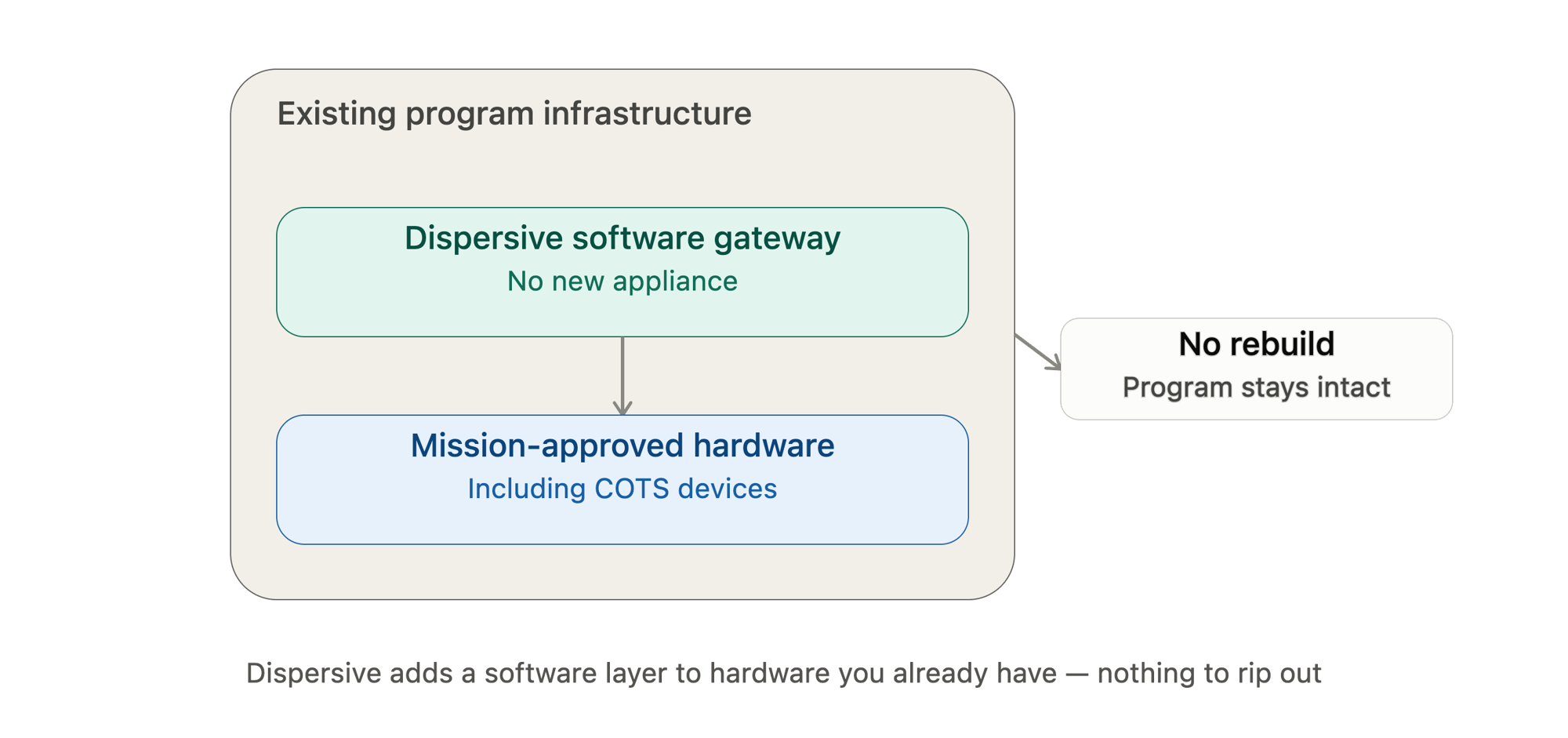
operational agility deployment

FAQs

Dispersive is built to defeat the operational objectives of Salt Typhoon, Volt Typhoon, and similar infrastructure-centric campaigns — attacks that target the routers, firewalls, carriers, and management systems carrying communications, not just the endpoints and identities most cybersecurity investment protects. A single compromised router can expose who's talking to whom, how often, and why, even when every message is fully encrypted. Dispersive is built specifically to deny that visibility.

Dispersive divides communications into independently encrypted segments and dynamically distributes them across multiple independent transport paths, so no single observation point ever sees a complete communication. It assumes contested infrastructure rather than trusted infrastructure and adapts around compromise instead of depending on its absence.

No. Dispersive is a layer of communications resilience added on top of an organization's existing defenses, extending zero trust architecture from identity and endpoints out to the transport layer itself.

Yes. Dispersive architecture aligns with NIST-approved post-quantum cryptographic standards, including ML-KEM, supporting the Federal Government's accelerated transition of high value assets and national security systems to post-quantum cryptography.

Dispersive® Stealth Networking Solutions

Fortifying Networks with Secure, Resilient, and High-Performance Connectivity

DispersiveCloud

DispersiveCloud™ is a hosted SAAS SOC 2 Type II-compliant solution that brings the power of our groundbreaking network fabric that simplifies the deployment and management process without compromising performance or security. We operate on state-of-the-art cloud networks, partnering with various vendors, including Amazon Web Services and Azure to enable global high availability.
Government

DispersiveFabric

DispersiveFabric™ is our robust, flexible solution designed for larger, more complex environments. A software-defined overlay network, DispersiveFabric™ utilizes a microservices architecture to provide unparalleled security, reliability, and performance. Deployable on any type of infrastructure with infinite scale- public cloud, private cloud, containers, VMs, dedicated hardware.

iStock-1361547059 (1)

The Network Is Now the Frontline

Most mission planning still assumes the communications layer is trustworthy. That assumption is rarely tested until it's wrong, and by then, the damage is already done. Teams have lost decision advantage, exposed coalition partners, and let adversaries study their operations undetected. This isn't something another firewall or policy fixes. Instead, it's an architecture decision put in place before the mission depends on it. Schedule a consultation with our federal team to see what that architecture looks like for your specific environment.