



TREND REPORT
Coincidence, coordinated cyberattack, or a warning about America’s digital infrastructure?
An unusual sequence of disruptions across aviation, banking, enterprise software, cloud services, and national security communications raises a troubling question. What if the next major infrastructure attack looks, at first, like a collection of unrelated accidents?
Imagine discovering that your bank cannot process transactions. You try to reach colleagues, but email is unavailable. Cloud applications are inaccessible. Flights are delayed. A government communications system is reportedly down. Each organization offers a different explanation: a software defect, a failed update, a router problem. Nothing necessarily looks like an attack.
But what if those services depend on the same underlying technologies? What if disrupting a small number of critical components can affect millions of people? And what if a determined adversary could exploit those dependencies while making the resulting failures look unrelated?
Those questions are worth asking. They are not proof of a coordinated operation, and several of November’s incidents already have plausible, nonmalicious technical explanations. The important question is whether the sequence reveals vulnerabilities that a future adversary could deliberately exploit.
| Date | Event | Reported impact and explanation |
|---|---|---|
| Nov. 12 | Microsoft Outlook / 365 | Email and collaboration disruption; software and infrastructure problems reported [2] |
| Nov. 13 | FAA | Nationwide ground stop; router and network instability reported [1] |
| Nov. 13–14 | Workday | Production and disaster recovery difficulties reported [3] |
| Nov. 16 | JPMorgan Chase | Transaction delays with downstream effects at other banks; software bug reported [4–5] |
| Nov. 16 | United Airlines | Departure delays associated with operational technology [6] |
| Nov. 17 | NSA Net | Reported classified network disruption; routine patching implicated [7] |
| Nov. 17 | Apple services | Multiple cloud, account, and related services affected; cause not yet established [8] *editors note: “Many of our systems are back up and running after an internal update caused some outages this morning,” an Apple spokesperson told NBC News on November 17th. |
Two other items circulating this week do not belong in a verified disruption count. A scheduled FEMA Emergency Alert System test is not an outage [9], and claims of a forthcoming 90-day nationwide power grid shutdown are unsupported. Downstream banking complaints should not be mistaken for independent breaches at every bank, either.
The FAA described network instability involving approximately 1,000 connection attempts every four to five seconds. Legacy equipment became unstable at 17 of 22 en route centers, and a nationwide ground stop followed. Investigators traced the excess traffic to two possible originating locations and disabled the implicated functionality on more than 60 routers [1]. The FAA has since paused installation of the new routers [1]. Transportation Secretary Sean Duffy said national security agencies told him the failure was not a cyberattack, yet he still asked the FBI to join the analysis of the Arkansas router [11]. Even officials confident in a benign explanation chose not to wait for attribution.
The lesson is larger than aviation. A seemingly limited infrastructure problem can produce consequences far beyond the device where it begins. Whether an error or an adversary triggers it, the effects can cascade through a national operation.
Chase attributed its November 16 transaction delays to a software bug. Customers at other institutions could still see delays, because financial transactions cross institutional boundaries [4–5]. Multiple customer-facing failures need not mean multiple independent root causes. In interconnected systems, an organization can suffer the consequences of a failure it never experienced itself.
Large systems fail regularly. Independent defects, maintenance mistakes, and ordinary reporting attention can make a short period seem exceptional. We cannot call the cluster statistically unusual without comparing it against a historical outage baseline.
Cloud platforms, identity services, software suppliers, telecommunications carriers, DNS, routing, and financial processors create dependencies across seemingly unrelated organizations. Different incidents may expose a common architectural weakness without sharing a single defective device or a common attacker.
Officials are already pointing in this direction. Director of National Intelligence Jay Clayton said, “This is not a cyberattack, and this is not a coordinated effort by a nation-state” [12]. Senate Intelligence Committee Vice Chair Mark Warner went further. In a statement, he said “AI is making it possible to identify vulnerabilities across enormous numbers of systems at unprecedented speed,” which puts pressure on companies and government agencies to patch those vulnerabilities immediately, often all at once [13]. If that holds, the common thread is not an attacker but a shared operating condition: organizations patching faster than they can safely test. The FAA’s own explanation, a router installation, does not fit that pattern neatly, a reminder that a shared narrative can mislead as easily as a shared attacker.
A sophisticated actor could exploit privileged access or shared infrastructure to cause disruptions that are distributed geographically and operationally. This is a plausible threat model, not a finding about November 2026. Credible attribution would require evidence beyond timing: matching malicious artifacts, shared compromised systems, or forensic linkage.
For now, independent technical failures and systemic dependency weaknesses have stronger public support than a coordinated campaign. The more consequential hypothesis should not be promoted simply because it is more dramatic.
An infrastructure-centric campaign could seek intelligence collection, persistent access, disruption of commerce, diversion of response resources, erosion of public confidence, or prepositioning for a future crisis. Publicly documented Volt Typhoon [14] and Salt Typhoon activity shows why infrastructure access matters, although the evidence reviewed here does not link either campaign to the November events.
Picture an army trying to halt a city’s commerce. It could attack every delivery truck, or it could disrupt a handful of critical bridges. Routers, identity providers, network carriers, and cloud control planes are the digital equivalent of those bridges. AI-assisted reconnaissance could make it easier to find exposed services and map dependencies, though nothing so far establishes adversarial use of AI in the observed outages.
The responsible approach is to identify priority scenarios rather than predict that a named company will fail. These categories are worth monitoring because each can produce cross-sector consequences:
| Infrastructure category | Possible cascading consequence |
|---|---|
| Cloud identity and authentication | Users lose access to many otherwise healthy applications. |
| DNS, internet routing, and carriers | Multiple organizations become unreachable or lose critical connectivity. |
| Payment processing | Transaction delays spread across banks and merchants. |
| Cloud management and software updates | A control plane or deployment failure affects numerous customers. |
| Transportation and logistics | Dispatch, scheduling, and distribution services are interrupted. |
| Energy and operational technology | Regional services are disrupted if control systems or supporting communications fail. |
A hypothetical adversary might first map dependencies, then gain access, observe how organizations react to limited interference, and hold options in reserve for a future crisis. That is an illustrative campaign sequence, not an assertion that November’s incidents are its opening stages.
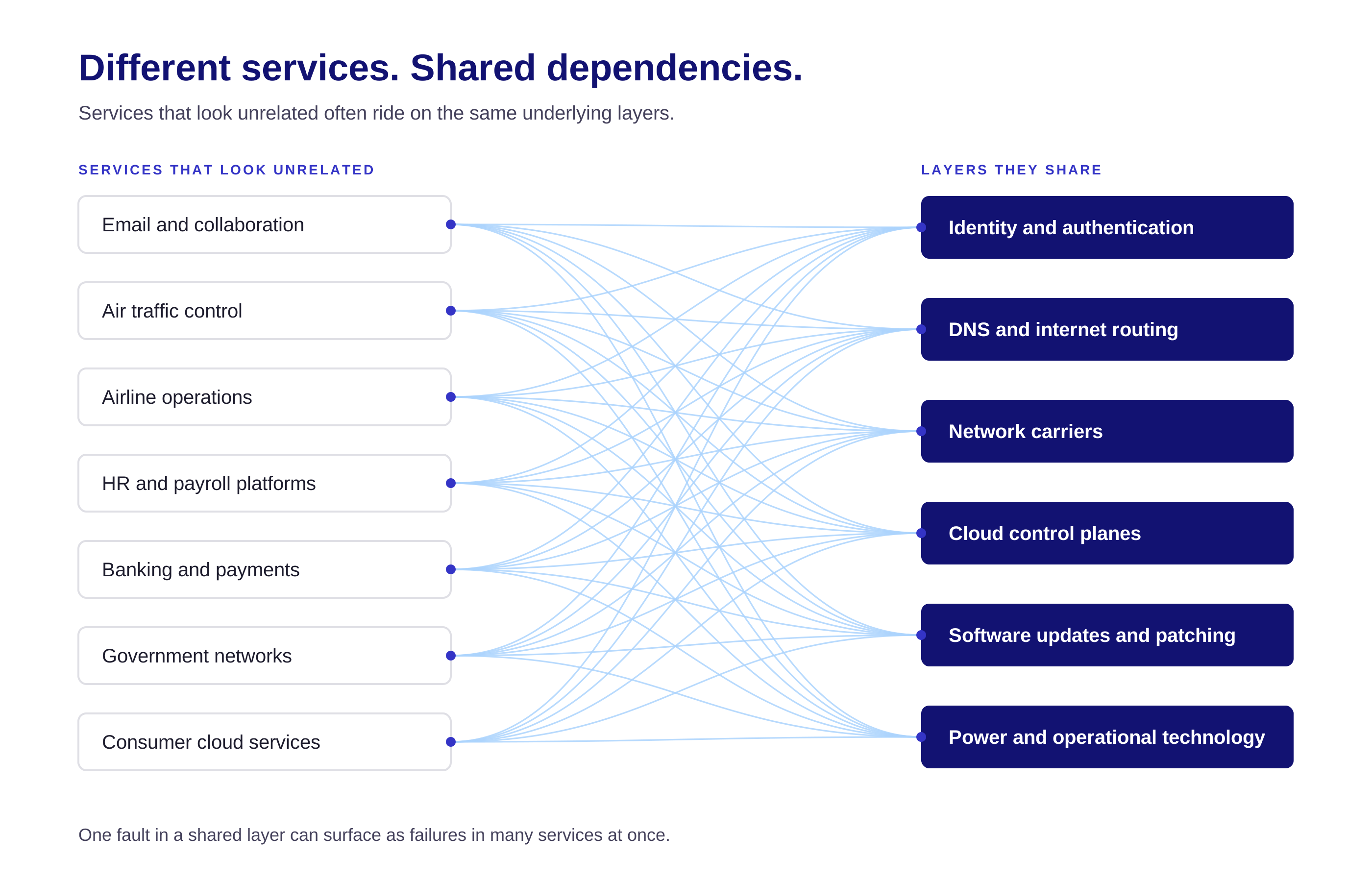
Suppose every incident ultimately proves accidental. No conspiracy, no shared adversary, no hidden campaign. Would that be reassuring? Only partly. It would mean ordinary technical problems were enough to interrupt prominent services across multiple sectors in a matter of days.
If ordinary failures can produce consequences like these, what could a determined adversary accomplish by deliberately targeting the same weaknesses? The central challenge is not only preventing intrusion. It is maintaining essential operations when a dependency becomes unavailable or untrustworthy.
Dispersive® Stealth Networking protects communications in software through encryption, encrypted microstreams, dynamic multipath transport, protected headers, identity-bound connectivity, and adaptive resilience. In the right deployment, it can reduce the exposure of nonpublic services, make interception and correlation across intermediate networks harder, and keep communications running through automatic path failover when independent alternate paths are available. Ovzon, for example, uses Dispersive as a break-glass path into sites that does not depend on its normal access mechanisms.
These capabilities work alongside endpoint security and application resilience. They will not repair a faulty router, fix a software defect, or protect data already exposed on a compromised endpoint, and they cannot create alternate paths where none physically exist. Their value depends on how each incident actually failed and how an organization’s architecture is built, which is why mapping dependencies comes first.
1. Map dependencies. Identify single points of failure across cloud, identity, carrier, DNS, payment, and software providers.
2. Reduce exposure. Remove unnecessary internet-facing services and restrict administrative interfaces.
3. Strengthen identity. Use phishing-resistant multi-factor authentication (MFA), conditional access, and short-lived credentials where practical.
4. Test independent paths. Verify that alternate carriers and routes do not share hidden points of failure.
5. Prepare offline procedures. Keep emergency contacts and essential operating instructions available without cloud access.
6. Stage changes. Use controlled deployment, rollback, and tested disaster recovery.
7. Constrain AI agents. Limit tool privileges and network destinations for automated workflows.
8. Exercise outages. Simulate the loss of email, authentication, connectivity, and payment processing.
9. Protect critical communications. Use appropriate encryption and resilient transport for high-value operations.
10. Correlate evidence. Investigate repeated failures involving common vendors, updates, and infrastructure.
For more practical guidance on limiting exposed services, constraining agent access, and reducing reconnaissance opportunities, read Agents Can’t Attack What They Can’t See: An Engineer’s Read on ARTEX by Scott Higgins, Senior Director of Engineering at Dispersive [10].
Look for independent organizations reporting the same failed dependency, repeated postmortems that identify similar configuration or update mechanisms, credible evidence of unauthorized infrastructure access, and failures that propagate across sectors. Unrelated, verified root causes would weaken the coordinated-campaign hypothesis. No single anomaly proves an attack.
Organizations should not wait for definitive attribution to improve resilience. Whether the next disruption is accidental or deliberate, the operational consequences may look remarkably similar.
Perhaps the November disruptions are an unusual coincidence. Perhaps they expose systemic weaknesses. Perhaps future evidence will reveal relationships that are not visible today.
What we already know is that concentrated digital dependencies can turn limited faults into widespread consequences, and sophisticated adversaries have incentives to exploit that reality.
The next major cyberattack may not announce itself with ransomware demands or dramatic warnings. It may look like an ordinary day when several things simply stop working. Will we recognize the dependencies, and can we keep operating when trust breaks down?
Dispersive Denies the Adversary’s Battlefield Advantage.
Whether the next disruption comes from a rushed patch, a failed router, or an adversary who has studied both, the question is the same: which of your critical communications have a second path, and which do not? Our team will work through that with you and show how Dispersive keeps critical communications running when a primary path fails.
Talk to our team about communications resilience →
This Trends Report examines reported disruptions and their implications for security and resilience. It distinguishes confirmed incidents and reported technical explanations from hypotheses and future scenarios. As of November 18, 2026, the public evidence reviewed does not establish that the events were a coordinated cyberattack.
[1] FAA, Nationwide Ground Stop: Questions and Answers
[2] AP, Microsoft outage
[3] FAU, Workday notice
[4] Reuters, Downdetector reports outages at major U.S. banks
[5] AP, Banking outages
[6] KRLD, Technical glitches disrupt Microsoft, FAA, banks, and United in one week
[7] CBS News, NSA’s classified internal network goes down
[8] Engadget, iCloud and other Apple services are down in an apparent outage
[9] FCC, Emergency Alert System advance notice
[10] Dispersive, Agents Can’t Attack What They Can’t See: An Engineer’s Read on ARTEX
[11] Engadget, FAA suspends installation of router that led to a ground stop of flights across the US
[12] WOKV, National intelligence director says no signs of cyberattack amid tech outage concerns
[13] The Hill, Senate Intel Vice Chair Warner says AI contributing to network outages

