
Mission Communications That Survive the Environment

At the tactical edge, the network is the constraint. Links degrade, satellite beams drop, cellular is congested or contested, and the transport an operator depends on is usually infrastructure someone else owns and may already be inside. Dispersive® Stealth Networking treats those conditions as the baseline, not the exception.

Dispersive splits each session into independently encrypted segments and distributes them across every available path at once: fiber, cellular, satellite communications (SATCOM), line-of-sight radio, and commercial internet. Lose a path and traffic continues on the rest, with no reconnect and no operator action. Mission applications keep running through disconnected, denied, intermittent, and limited bandwidth (DDIL) conditions, and no single tap point ever holds a complete session. That holds in both directions: edge to cloud into AWS, Azure, and private cloud, and edge to edge between forward nodes with no cloud round trip.

Edge to Cloud and Edge to Edge

Mission traffic reaches cloud-hosted applications and moves directly between forward nodes across the same overlay. Peer-to-peer links between edge sites do not transit a cloud region or a central concentrator, which removes both the latency penalty and the single point of observation that a hub-and-spoke design creates.

Automated PACE Transitions

Primary, alternate, contingency, and emergency (PACE) path changes happen in software and in real time across radios, SATCOM, cellular, and terrestrial links. Operators are not manually failing over mid-mission. Sessions do not drop while a transport is re-established.

Deployment That Matches the Program

Dispersive can host and operate the control plane, or the program can host and control it entirely. Sovereignty, accreditation, and air-gap requirements set the model, and the architecture supports all of them.

What Are Resilient Tactical Edge Communications?

Resilient tactical edge communications is the practice of designing forward-deployed mission networks so that connectivity survives the loss, degradation, or compromise of any individual transport path. Rather than detecting a failure and switching to a backup link, a resilient architecture distributes each session across multiple independent paths at once, so that losing one path reduces capacity instead of ending the session.

Five Edge Patterns, One Overlay

The same architecture supports five distinct edge patterns, each with a different transport reality:

Expeditionary and Forward-Deployed Operations — Assured connectivity for teams operating on whatever transport is available, with no fixed infrastructure to depend on.

Edge-to-Cloud Mission Applications — Resilient gateways connecting forward sites to mission applications hosted in AWS, Azure, and private cloud.

Edge-to-Edge Mission Links — Direct site-to-site and peer-to-peer connectivity between forward nodes, with no dependency on a cloud round trip.

Unmanned and Autonomous Platforms — Continuous command, control, and telemetry links for platforms whose available transport changes as they move.

SATCOM and Multi-Orbit Dependence — Multipath aggregation across satellite, terrestrial, and cellular links, so a degraded beam or orbit reduces capacity instead of ending the session.

Abstract waves Image by Alexandra_Koch from Pixabay

How Transport Behaves
When the Network Does Not Hold

Single-path architectures fail over after a problem is detected. Multipath segmentation removes the failure event. Post-quantum cryptography extends throughout the Dispersive data plane and control plane, incorporating FIPS 140-3 validated cryptographic modules and NIST-standardized ML-KEM and ML-DSA.


VPN / Encrypted Tunnel

SD-WAN

Dispersive® Stealth Networking

Path use

One tunnel over one active path.

Multiple links available, one active path per session.

Every available path at once. Each session is split into independently encrypted segments.

When a path degrades

Session drops. The user reconnects when a path returns.

Failover begins after the problem is detected. The session may reset.

Capacity reduces. The session continues with no reconnect and no operator action.

What one tap point yields

The complete encrypted session, plus who is talking to whom and when.

The complete encrypted session for that link.

Fragments that cannot be correlated into a session, a topology, or a schedule of operations.

Who runs the control plane?

Customer-operated, but dependent on a concentrator that is a single point of visibility and failure.

Typically a vendor-hosted controller, with a required vendor appliance at each site.

Either model. Dispersive can host and operate the control plane, or the program hosts it and controls everything.

Captured today, decrypted later

One captured session decrypts once the keys break.

One captured session decrypts once the keys break.

An adversary must discover every path, capture every segment, and preserve the timing between them before decryption matters.


Mission Outcomes

Communications Continuity

A VPN or SD-WAN session is tied to the health of its one active path, and failover only begins after a problem is detected. Dispersive uses multiple independent paths simultaneously and shifts segment distribution as conditions change. Degradation shows up as reduced capacity rather than a dropped session. PACE transitions run automatically across radios, SATCOM, cellular, and terrestrial transports.
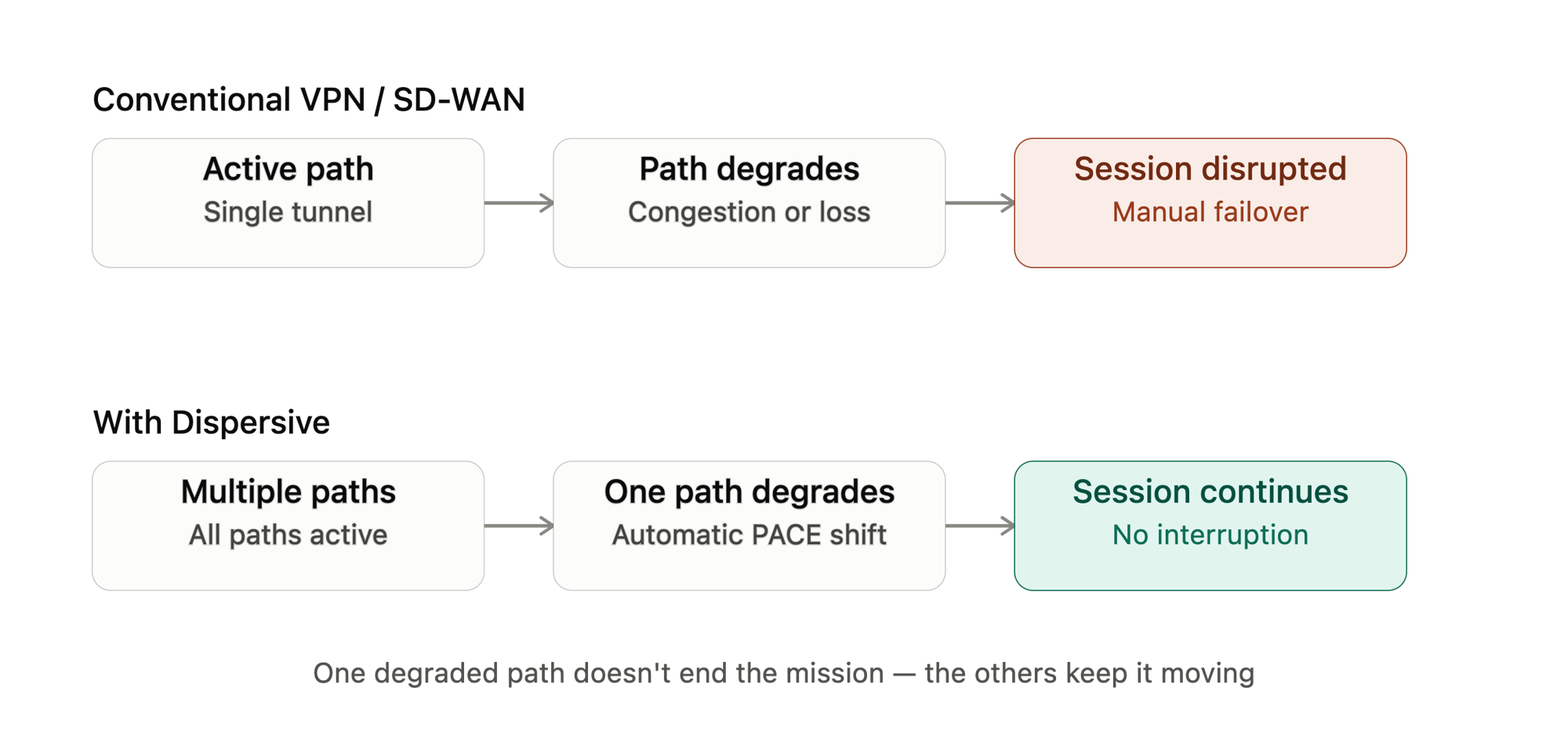
Diagram of operational continuity
Low Observability

Traffic analysis at the edge produces pattern of life. Dispersive denies it. Segments of one session traverse different paths and different carriers, so an adversary tapping a single link recovers fragments that cannot be correlated into a session, a topology, or a schedule of operations. TLS fingerprint mitigation randomizes fingerprints or mirrors common browser profiles to reduce side-channel exposure.
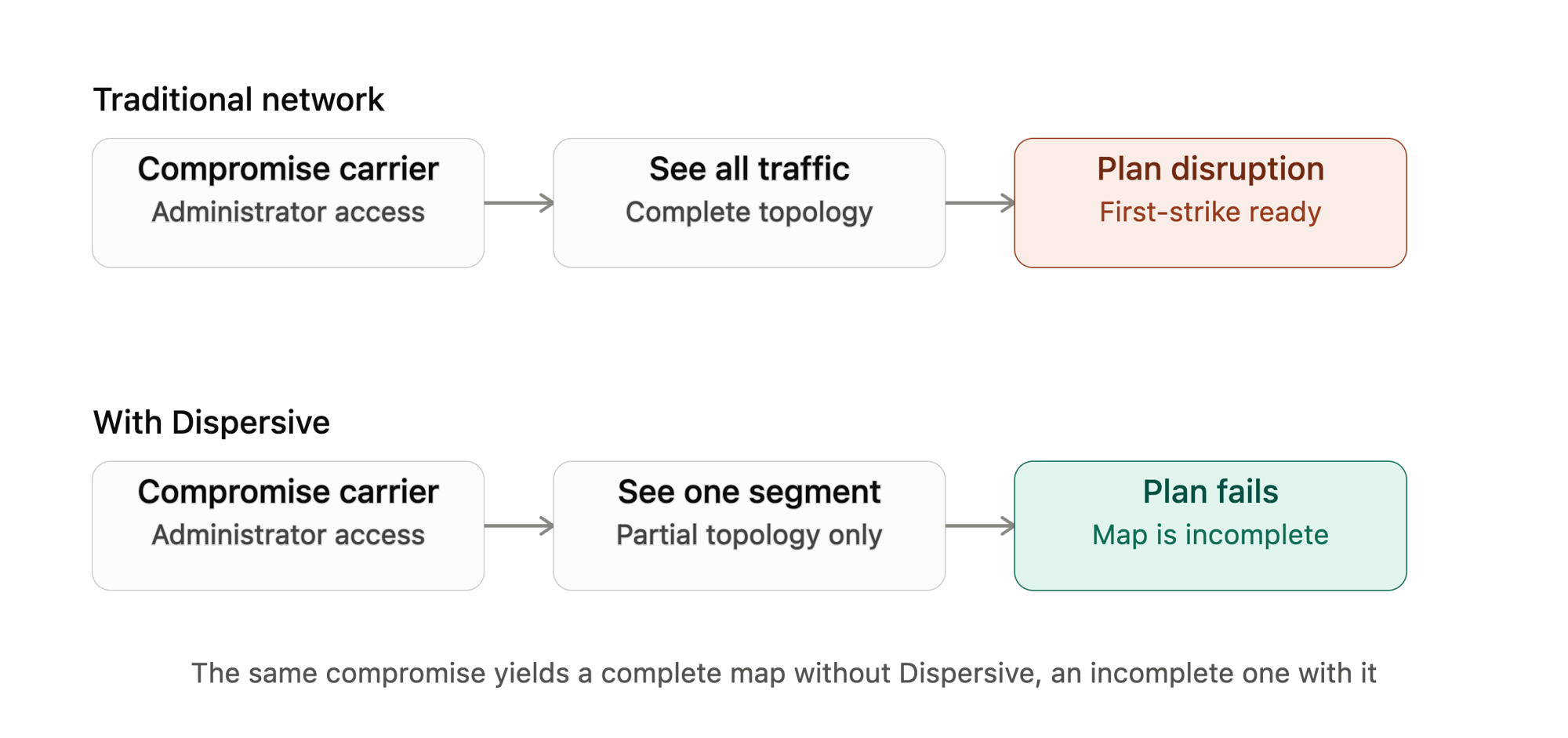
decision advantage topology
Quantum Resilience

Communications captured at the edge today are stored for decryption later. With AI, harvest now, decrypt later (HNDL) becomes harvest now, reconstruct later. Dispersive extends post-quantum cryptography throughout the data plane and control plane, incorporates FIPS 140-3 validated cryptographic modules, and supports NIST-standardized algorithms including ML-KEM and ML-DSA. Segmentation compounds that protection. An adversary has to discover every path, capture enough segments, preserve the timing and inter-path latency relationships between them, correlate them, and reconstruct the session correctly before decryption produces anything readable.
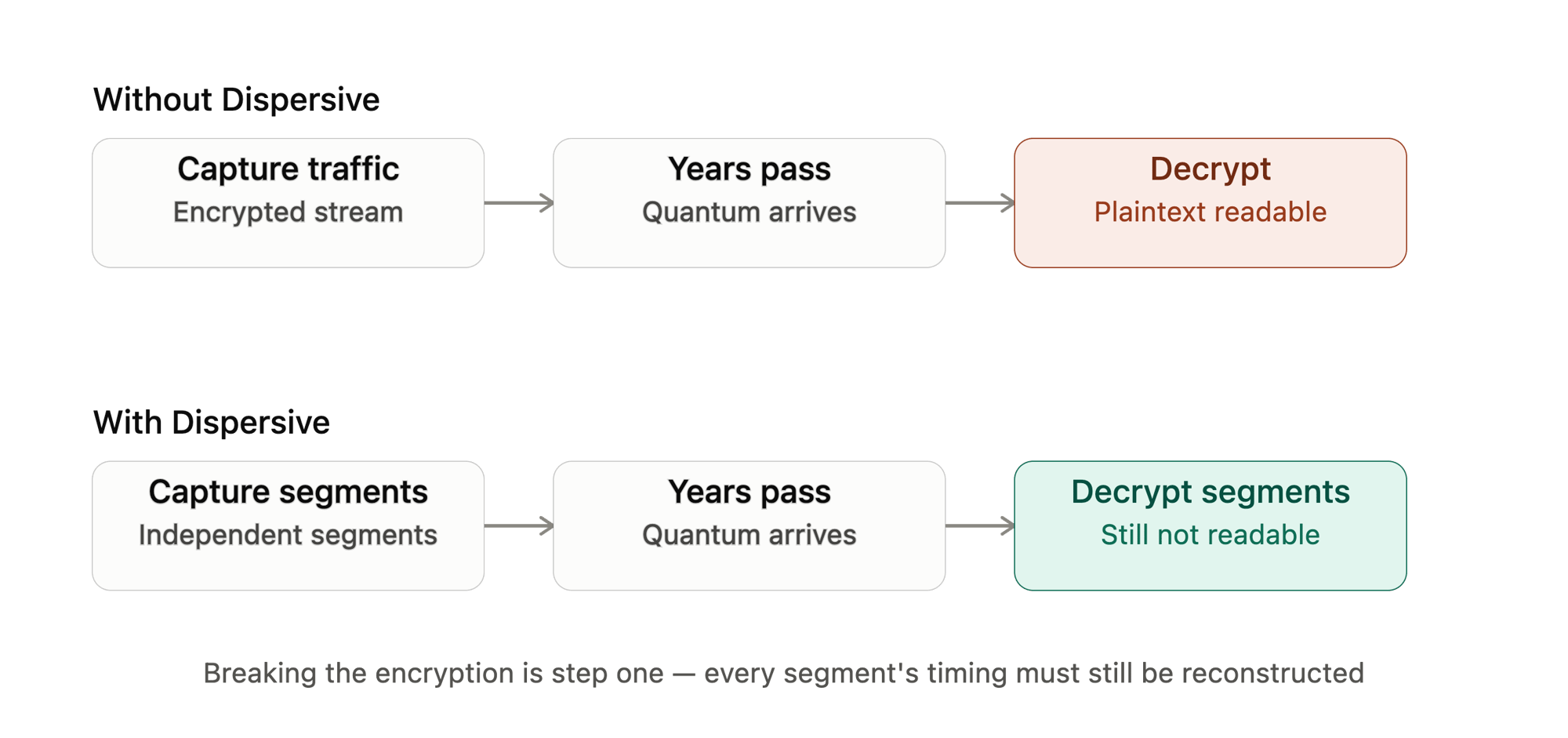
Harvest now reconstruct later diagram
Rapid Fielding

The gateway installs on hardware the program already owns and runs alongside existing transport and security investments. Integrators add resilient, low-observable transport to a program of record without a rip and replace, and without a new appliance to sustain in the field.
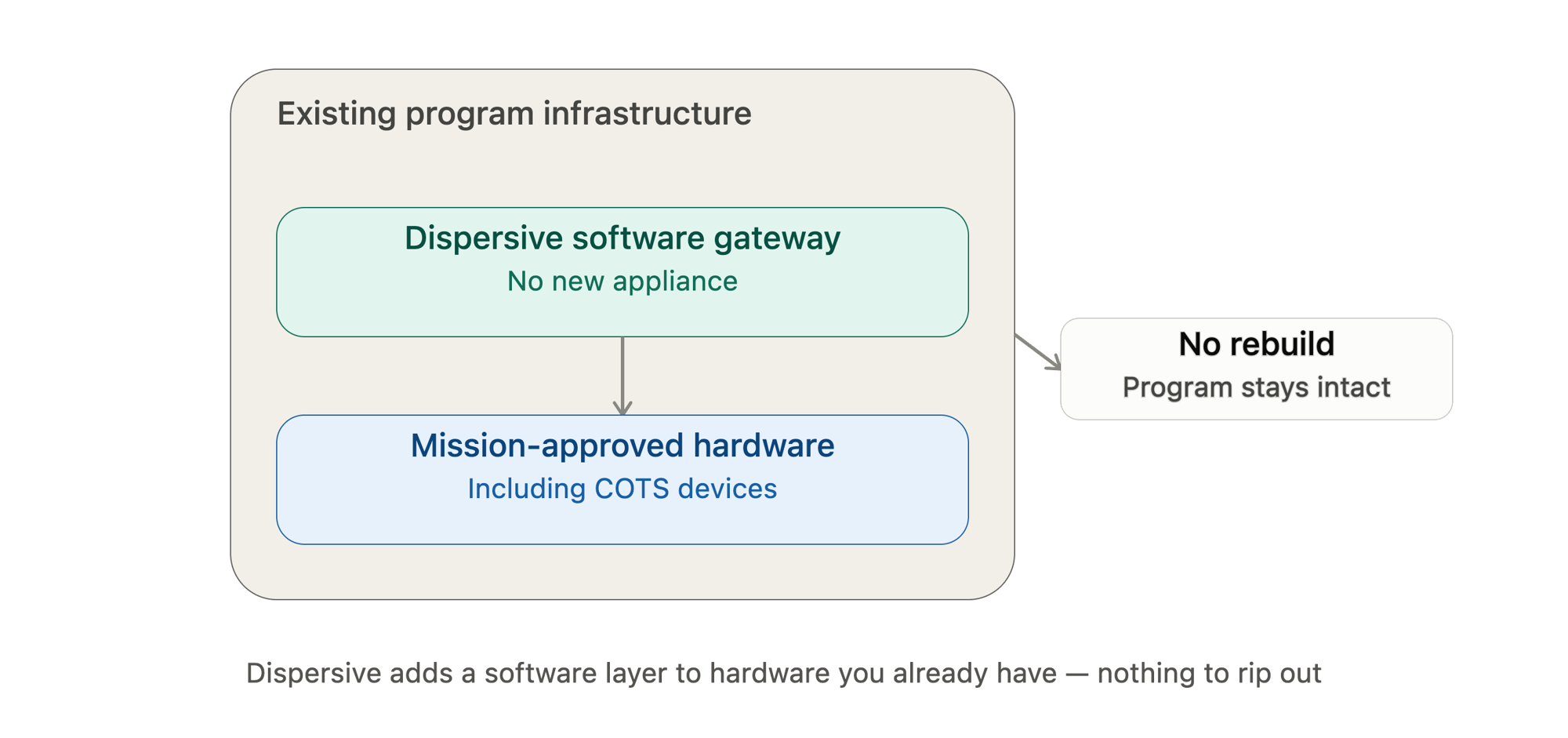
operational agility deployment

FAQs

Traffic continues on the remaining paths. Dispersive® Stealth Networking distributes every session across multiple independent paths at once, so losing one path reduces available capacity rather than ending the session. Path changes happen in software, with no reconnect and no operator action, across radios, satellite communications, cellular, and terrestrial links.

No. Dispersive runs over the transport already in place, including satellite communications, cellular, line-of-sight radio, fiber, and commercial internet. It aggregates those links into one resilient overlay rather than replacing any of them, so existing transport investments and contracts stay in use.

A VPN or SD-WAN tunnel carries a complete session over one active path and begins failover only after a problem is detected. Dispersive splits each session into independently encrypted segments distributed across multiple paths at the same time. There is no single tunnel to observe, block, or lose, and no failover event to wait on.

The Dispersive gateway deploys on mission-approved or customer-furnished equipment, in containers, on virtual machines, and in cloud instances. Programs can field it on infrastructure they already own and sustain rather than introducing a new appliance into the logistics chain.

DDIL stands for disconnected, denied, intermittent, and limited bandwidth: the conditions in which connectivity is unavailable, actively contested, unreliable, or constrained to low throughput. Dispersive treats these as the operating baseline. Because each session is distributed across every available path, degradation on any one path reduces throughput rather than interrupting the mission application.

Yes. Dispersive extends post-quantum cryptography throughout the data plane and control plane, incorporates FIPS 140-3 validated cryptographic modules, and supports NIST-standardized algorithms including ML-KEM and ML-DSA. That supports migration planning under Executive Order 14412 and OMB Memorandum M-26-15 and the CNSA 2.0 requirement that national security system procurements natively support quantum resilience from January 1, 2027.>

No. Dispersive extends zero trust from identity and endpoints out to the transport layer itself, and it operates after authentication. It is an added layer of communications resilience on top of existing defenses, including active defense and endpoint protection, not a substitute for any of them.

Dispersive® Stealth Networking Solutions

Fortifying Networks with Secure, Resilient, and High-Performance Connectivity

DispersiveCloud

DispersiveCloud™ is a hosted SAAS SOC 2 Type II-compliant solution that brings the power of our groundbreaking network fabric that simplifies the deployment and management process without compromising performance or security. We operate on state-of-the-art cloud networks, partnering with various vendors, including Amazon Web Services and Azure to enable global high availability.
Government

DispersiveFabric

DispersiveFabric™ is our robust, flexible solution designed for larger, more complex environments. A software-defined overlay network, DispersiveFabric™ utilizes a microservices architecture to provide unparalleled security, reliability, and performance. Deployable on any type of infrastructure with infinite scale- public cloud, private cloud, containers, VMs, dedicated hardware.

iStock-1361547059 (1)

Glossary of Terms

A category of network conditions in which connectivity is unavailable, actively contested, unreliable, or constrained to low throughput. DDIL describes the normal operating environment for tactical and expeditionary communications rather than an exception to it. Architectures designed for DDIL conditions assume any individual transport path will fail, and treat continuity as a property of the design rather than as a recovery procedure.

A communications planning method that designates an ordered set of transport options, so operators know which path to use when the preceding one becomes unavailable. Traditional PACE execution is manual: an operator recognizes the failure and switches. Automated PACE moves those transitions into software, so path changes happen in real time without operator action and without dropping the session.

The forward end of a mission network, where connectivity depends on whatever transport is available rather than on fixed infrastructure. Tactical edge nodes typically combine satellite, cellular, line-of-sight radio, and commercial internet links, often owned and operated by third parties. The defining characteristics are changing transport availability, limited bandwidth, and physical exposure.

Communications carried over infrastructure that an adversary is actively attempting to observe, degrade, deny, or manipulate. A contested environment differs from a merely unreliable one in that failures may be deliberate and targeted. Designing for contested environments assumes the adversary is already positioned inside the transport path, and treats the confidentiality of traffic patterns as seriously as the confidentiality of content. Before building, confirm whether multipath obfuscation and moving target defense already have glossary entries. If not, they belong in the same batch, since both are mechanism terms this page depends on and neither is defined anywhere a first-time reader would find it.

Plan for the Network You Will Actually Have

Most mission planning assumes the communications layer will hold. At the tactical edge it frequently does not, and the cost is not only lost connectivity. It is lost decision advantage, exposed mission partners, and an adversary that has been studying the pattern of operations the whole time. Transport-layer resilience is an architecture decision made before the mission depends on it. Schedule a consultation with our federal team to see what that looks like on the transports your mission uses.