


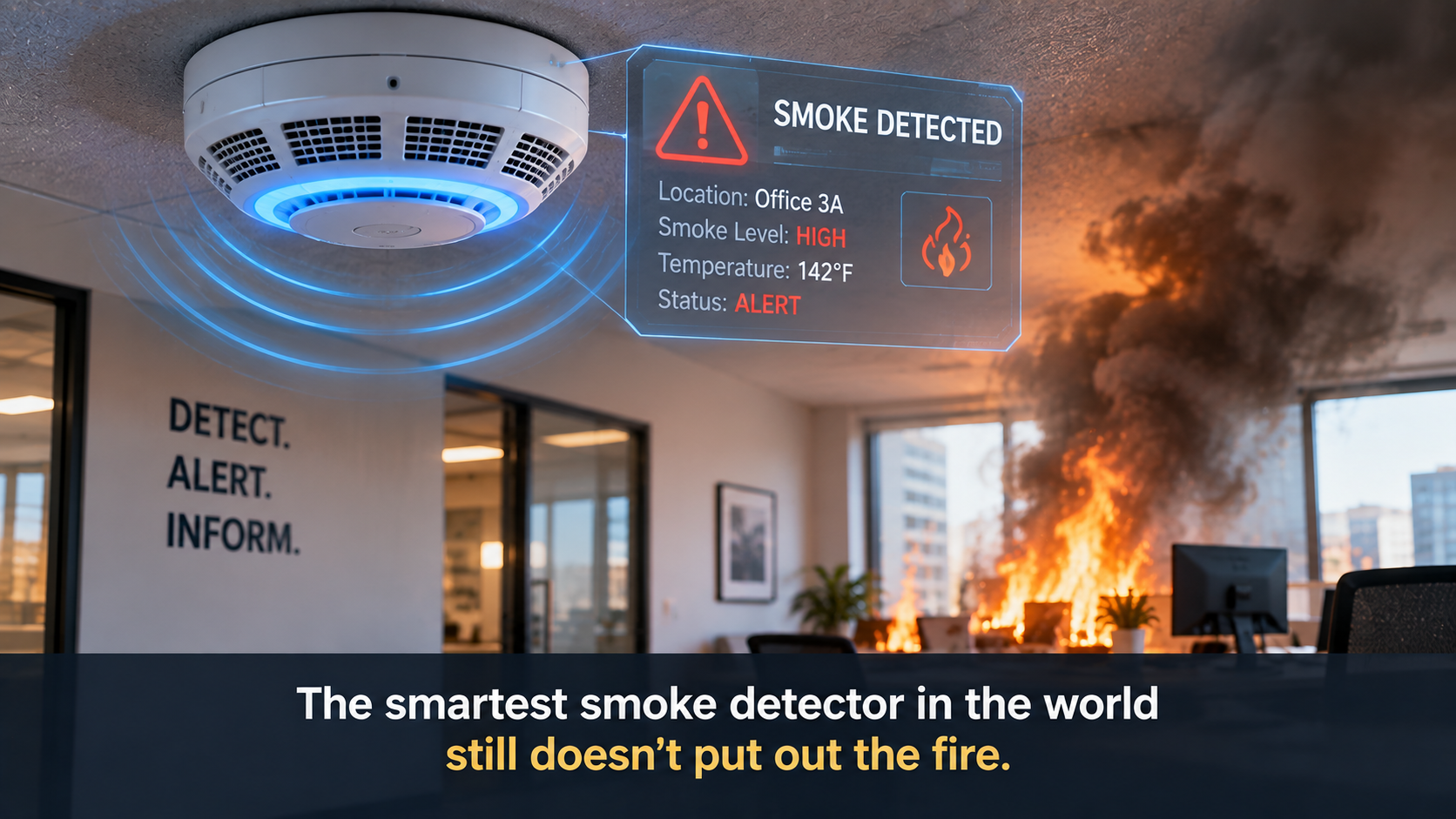
Imagine you have the world's smartest smoke detector. It doesn't simply smell smoke and sound an alarm.
Impressive. But there is a problem: Your house is still burning down. The smartest smoke detector in the world still doesn't put out the fire.
Perhaps we need to rethink what happens after we know there’s a problem.
Much of AI's cybersecurity value today comes from its ability to do something humans have always struggled to do at scale: make sense of enormous amounts of information quickly.
Networks, endpoints, applications, identity systems, cloud platforms, security tools, and operational systems generate enormous quantities of telemetry. Somewhere inside that data may be the first indication of an attack. AI can help identify anomalies, correlate events, recognize patterns, prioritize alerts, assist investigations, analyze malicious code, identify suspicious behavior, and accelerate decisions. Those are enormously valuable capabilities. But notice where many of them end:
The AI sees the fire. The AI understands the fire. The AI may even predict where the fire is going. But somebody, or something, still has to do something about it. That distinction may become one of the most important questions in the next generation of AI-enabled cybersecurity. What happens after the AI is right?
Let's return to our house. Suppose our extraordinarily intelligent smoke detector detects a fire in the kitchen. But now it can do more than issue an alert.
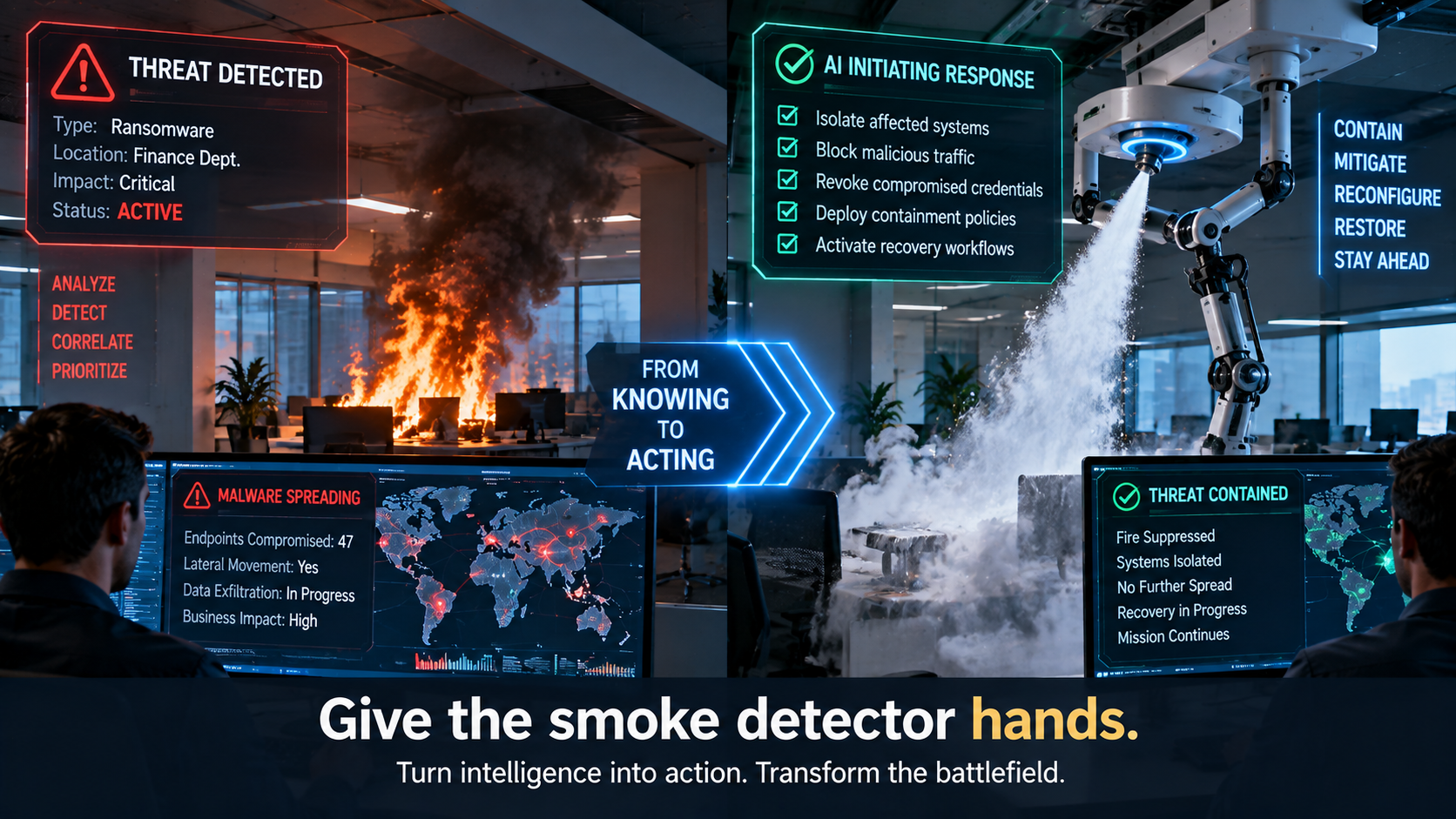
Now we have something fundamentally different. The system isn't merely observing the environment. It is changing the environment in response to what it observes.
The difference between Act and Transform is important.
Those can be exactly the right responses. But transformation asks a larger question: Can we change the environment the attacker is trying to exploit? That is a different way of thinking about AI-enabled defense.
Imagine a military commander learns that an adversary has targeted a particular bridge.
All may be appropriate. But suppose the commander's forces are no longer dependent upon that bridge. They can immediately move over several other routes. Traffic shifts. The adversary's targeting information becomes less valuable. The mission continues. The defender hasn't merely detected the attack. The defender has changed the battlefield.
Cybersecurity can increasingly ask the same question. If AI determines that a communications path is being degraded, monitored, attacked, or behaving abnormally, must the mission continue using that same path while another security system tries to eliminate the threat? … Not necessarily.
What if the communications environment itself can change?
The mission could continue while the underlying security problem is investigated. The goal changes from: Find the attacker faster to make what the attacker is doing less consequential. That is a very different objective.
This leads to a deliberately simple formulation:
Technically, reality is more complicated. Intelligence itself can contribute enormously to defense, and automated action can be dangerous when the underlying information or decision is wrong. But the distinction is useful. Knowing something and changing something are not the same thing.
Suppose an AI system determines with 99.9 percent confidence that a particular network route is under attack. Excellent! … Now what?
If the system merely generates an alert that waits in a security operations center queue, the AI has improved our knowledge (assuming the alert isn’t ignored). If that knowledge allows the architecture to respond safely and appropriately, the AI can potentially improve the mission outcome. That's where the opportunity becomes much larger.
There is an obvious danger here. If giving AI the ability to observe is useful, giving AI the ability to act may be more useful. It may also be more dangerous. AI that can recommend shutting down a server is fundamentally different from AI authorized to shut down the server itself. AI that identifies suspicious network activity is different from AI that can automatically restructure communications across an enterprise.
And increasingly autonomous agents make these questions more important, not less. So Secure WITH AI does not mean: Give AI unlimited authority and let it run cybersecurity. It means designing controlled mechanisms through which AI-derived intelligence can produce bounded, observable, reversible, policy-governed actions. That might include: recommendation only → human approval → limited automated response → policy-bounded autonomous response depending upon the mission, consequence, confidence level, and risk tolerance.
The smoke detector should be able to activate the sprinkler … That doesn't mean it should be allowed to demolish the house.
There is another assumption worth questioning. Many cyber defenses implicitly protect relatively static things.
Those activities remain essential.
But AI creates the opportunity for security architectures that are more adaptive. Instead of merely protecting a static environment, the environment itself can increasingly respond to changing conditions. That concept already exists in many forms across computing and networking. Systems can scale resources, reroute traffic, fail over between services, isolate components, change policies, and recover from failures.
AI potentially adds another dimension: understanding why and when those changes should occur. The combination is important. AI can become the decision intelligence. The architecture can become the execution mechanism.
There is another everyday example. Your navigation application detects a major accident ten miles ahead. If it announces "There is a 90-minute traffic jam ahead," that's useful information. But you're still heading toward the traffic jam. What makes modern navigation powerful is the next sentence: "A faster route is available" and then: "Rerouting for you."
That is exactly the conceptual shift we're considering in cybersecurity. Not every threat has to be eliminated before its effect on the mission can be reduced. Sometimes the environment can adapt around it.
Consider a distributed organization communicating across several available network paths.
Today's network technologies can already measure many aspects of path performance and perform forms of routing, failover, and load balancing without AI. That distinction matters. AI doesn't need to replace those mechanisms. Instead, AI could potentially provide another level of context and decision support.
It might combine network telemetry, threat intelligence, behavioral indicators, mission priority, historical observations, infrastructure status, and predictive analysis to make a higher-level determination: Something about this environment has changed. Then the communications architecture can respond.
That's where Secure WITH AI becomes particularly interesting.
There is an important difference between ordinary automation and AI-driven adaptation. A traditional rule might say: If Path A fails, switch to Path B … Useful. A more sophisticated policy might say: If Path A latency exceeds X for Y seconds, reduce its traffic allocation … Better.
But imagine an AI system capable of reasoning across a broader context:
The AI therefore recommends changing the communications posture before Path A actually fails. Now we're moving from Reactive failover toward Predictive resilience. That is potentially significant. The objective is no longer merely keeping the network functioning. It becomes: Keep the mission functioning while the threat environment changes around it.
Dispersive® Stealth Networking provides a useful example of an architecture capable of serving as part of that action layer. Importantly, this does not mean that Dispersive today should be characterized as an autonomous AI cybersecurity platform. That would overstate the current capability. The more interesting point is architectural.
Dispersive already provides mechanisms for distributing communications across multiple available paths, monitoring path conditions, adapting to path degradation or failure, and maintaining communications across heterogeneous network infrastructure. In other words, the communications environment can already change.
Now imagine increasingly sophisticated decision intelligence informing that adaptable environment. An AI-enabled security capability might determine that a particular transport has become suspicious. A network analytics system might recognize a pattern associated with an emerging attack. AI might predict that a particular route is becoming unreliable. A mission system might determine that one class of traffic has suddenly become substantially more important than another.
The Dispersive communications layer could potentially become one of the mechanisms through which those decisions affect the environment. The relationship would conceptually look like: OBSERVE → AI ANALYSIS → DECISION/POLICY → DISPERSIVE ACTION → CHANGED COMMUNICATIONS ENVIRONMENT
The AI doesn't merely say "Something bad is happening on Path A." The system can potentially respond "Then reduce our dependence on Path A." That's the difference between describing the battlefield and changing it.
This is important to the broader argument. Dispersive Stealth Networking is an example, not the premise. Other security technologies can also provide execution mechanisms. An AI-derived decision might cause:
The larger architectural idea is: AI becomes more consequential to defense when there is a safe mechanism connecting intelligence to action. That action layer may involve many technologies simultaneously. The interesting question for security architects becomes: What can the environment actually change when the AI discovers something important?
There is another reason the smoke-detector analogy matters. Imagine the system detects smoke and immediately floods the entire house with fire suppressant every time someone burns toast. Technically, it acted. Operationally, it failed. The future of AI-enabled cyber defense therefore cannot simply be about maximizing autonomous action. It must also be about confidence, consequence, authority, and reversibility.
The correct model will depend upon mission consequences. A consumer application, corporate network, hospital, financial system, military command network, industrial control system, and nuclear command environment should not necessarily delegate the same decisions to AI. The objective is not autonomy for autonomy's sake.
The objective is: Put machine speed where machine speed improves the mission while preserving human control where consequences require human judgment.
There is another reason this matters. Attackers will not use AI merely to write better phishing messages. Increasingly capable AI can potentially accelerate reconnaissance, vulnerability analysis, targeting, malware adaptation, exploitation, lateral movement, persistence, command decisions, and coordination. That means defensive AI may increasingly encounter adversarial systems that themselves move at machine speed. A purely human response cycle may become increasingly disadvantaged in situations where the attacker can observe → analyze → decide → act faster than defenders can detect → alert → investigate → approve → respond.
That does not mean humans should be removed. It means we should deliberately decide which portions of the defensive loop can safely operate at machine speed.
This brings us back to the burning house. Imagine spending millions of dollars creating the greatest fire-detection system ever built.
And then everyone stands around watching the dashboard while the house burns. That sounds absurd. Yet cybersecurity can fall into a similar trap when success is measured primarily by how quickly and accurately we detect something. Detection matters … Analysis matters … Prediction matters. But the mission ultimately cares about something else:
That suggests a different measure for AI cybersecurity: Don't measure only how quickly AI identified the threat. Measure how effectively the system changed the outcome.
This may ultimately be the larger idea. Traditional physical warfare has always understood maneuver.
Cybersecurity has historically been much more static. But increasingly distributed infrastructure, software-defined environments, cloud computing, multiple communications transports, automated orchestration, and AI create the possibility of something closer to cyber maneuver.
Instead of merely detect → block → restore, we can increasingly think: observe → understand → predict → maneuver → continue. The objective is not necessarily to eliminate every threat immediately. The objective is to prevent the threat from achieving its mission effect. That's a subtle but important shift:
The defender doesn't always have to defeat the attacker first. Sometimes the defender can make the attack matter less.
AI is giving cybersecurity extraordinary new ways to see.
We should exploit those capabilities. But we shouldn't confuse seeing with defending. The world's smartest smoke detector is still only a smoke detector until something can respond to what it knows. So perhaps the next generation of AI-enabled cybersecurity should not be defined solely by How much can the AI detect? or even How accurately can the AI predict? The more important question may be:
That is the transition from AI as an observer to AI as part of an adaptive defense. And it brings us back to the burning house. Don't just build a smarter smoke detector. Build a system that knows what to do when it smells smoke.
Maybe we need to rethink what happens after we know.
Dispersive protects the communications between users, models, agents, tools, and data as a lightweight overlay on the networks you already run. Your existing security stack stays in place.
📞 Schedule a briefing with Dispersive’s architects to assess your exposure and map a deployment path. www.dispersive.io
Header image courtesy of StakeCash from Pixabay.

