
The Dispersive Solution
Move the Problem From Mathematics to Collection
A quantum computer or a frontier AI model attacks the math. Neither puts a collector on every path at once. Dispersive® Stealth Networking splits each session into independently encrypted segments and sends them across multiple paths that keep changing. Headers are encrypted as well as payloads, using separate AES-256 keys, so a collector cannot tell which segments belong to a given conversation.
Dispersive installs as a lightweight overlay, as the DispersiveCloud® managed service or DispersiveFabric™ on premises. Keep the encryption you already run: Dispersive encapsulates existing traffic inside its post-quantum protected transport, and none of the endpoints, appliances or encryptors on your migration plan change. Your highest-consequence paths are protected while the rest of the estate is still being inventoried.
Cryptography inside applications, endpoints and stored data remains part of the broader post-quantum program. Dispersive protects the communications it carries, from the day it is deployed. See the Dispersive network architecture.
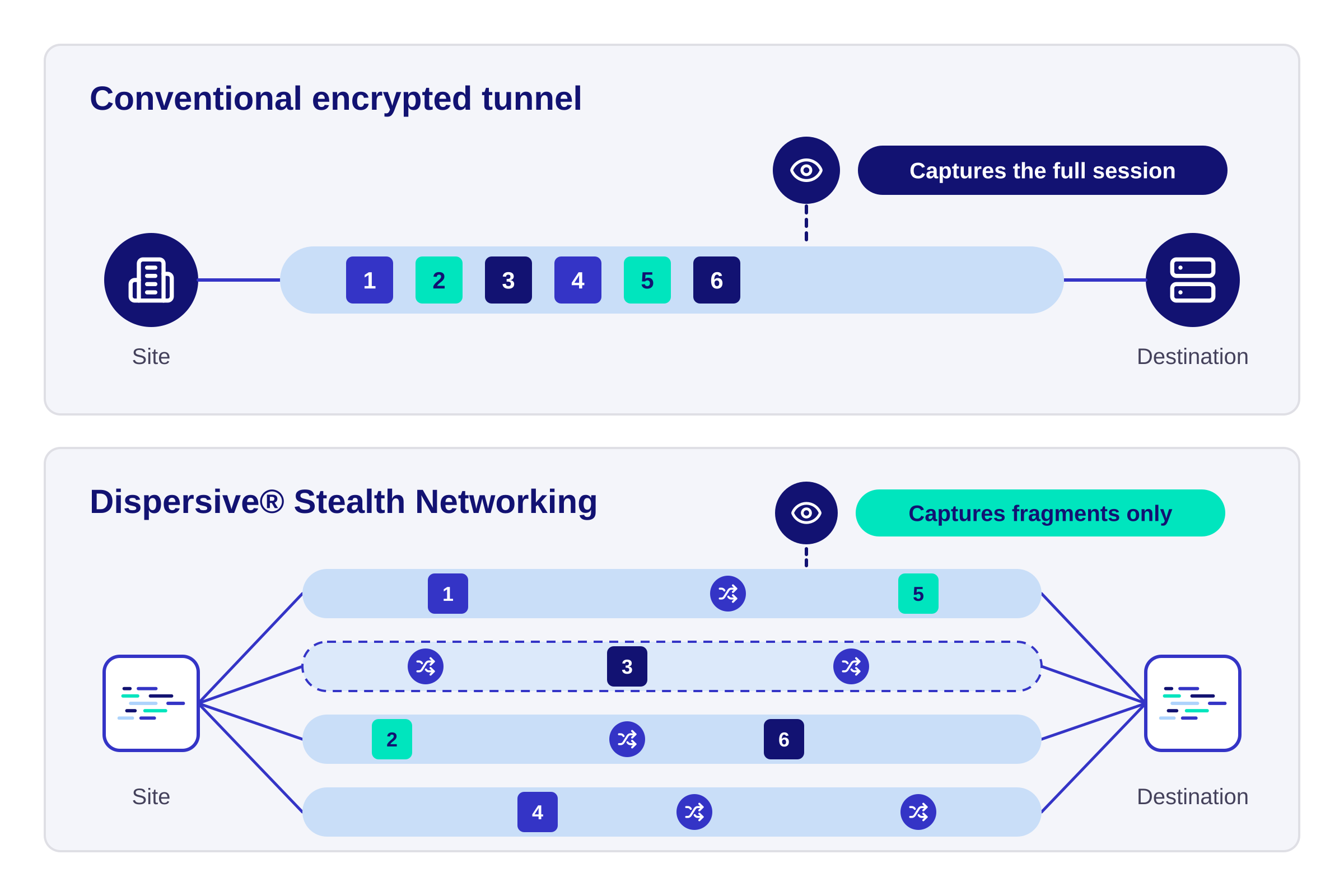
Inside the Dispersive PQC Solution
Post-Quantum Cryptography on Both Planes
Dispersive applies NIST-standardized ML-KEM and ML-DSA across the data plane and the control plane, incorporating FIPS 140-3 validated cryptographic modules. Headers and payloads use separate AES-256 keys, so compromising one does not expose the other. AES-256 is the symmetric algorithm specified in CNSA 2.0, so together this covers all three parts of the CNSA 2.0 core: key establishment, signatures and data transport. Traffic carried over Dispersive is post-quantum protected from the day it is deployed.
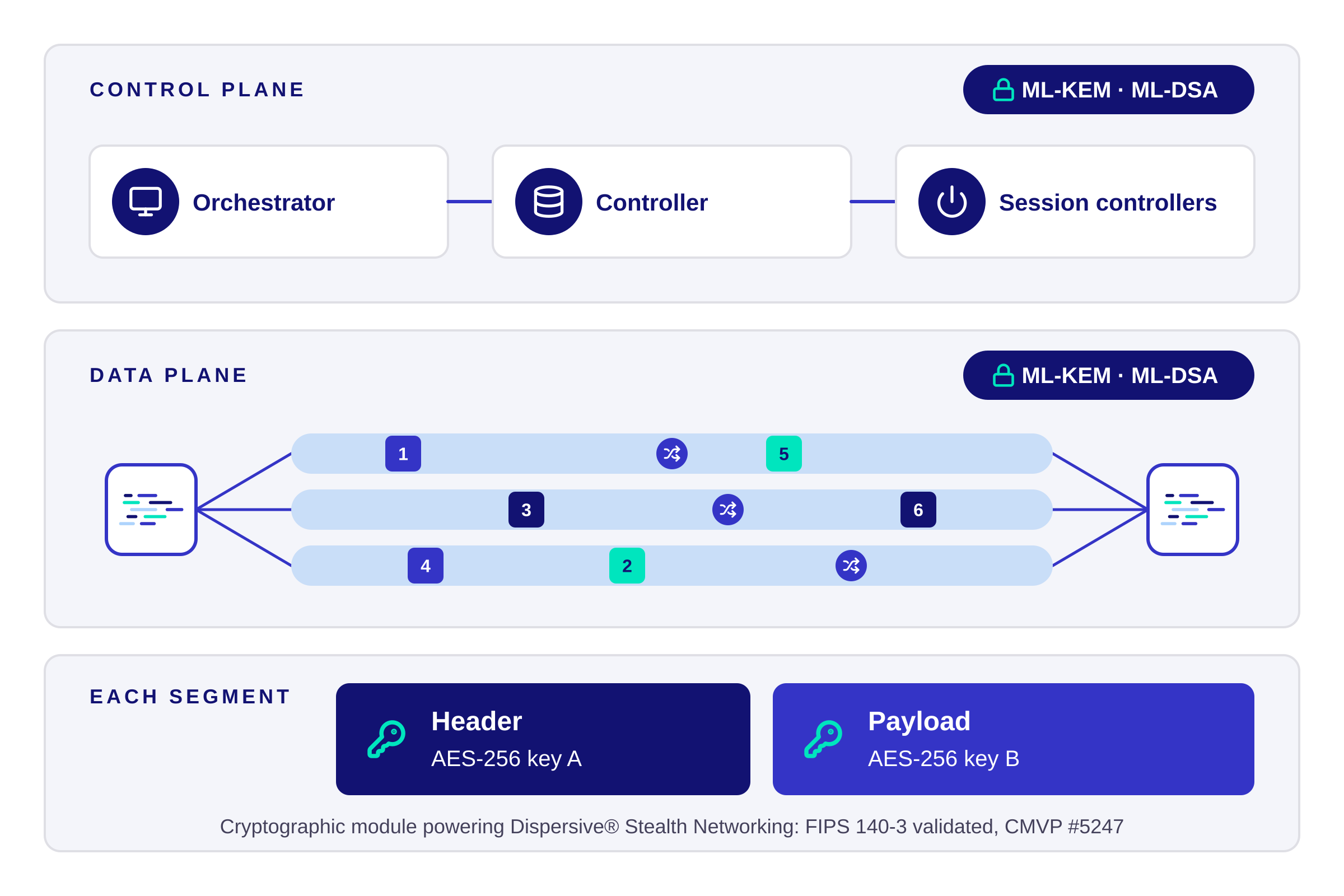
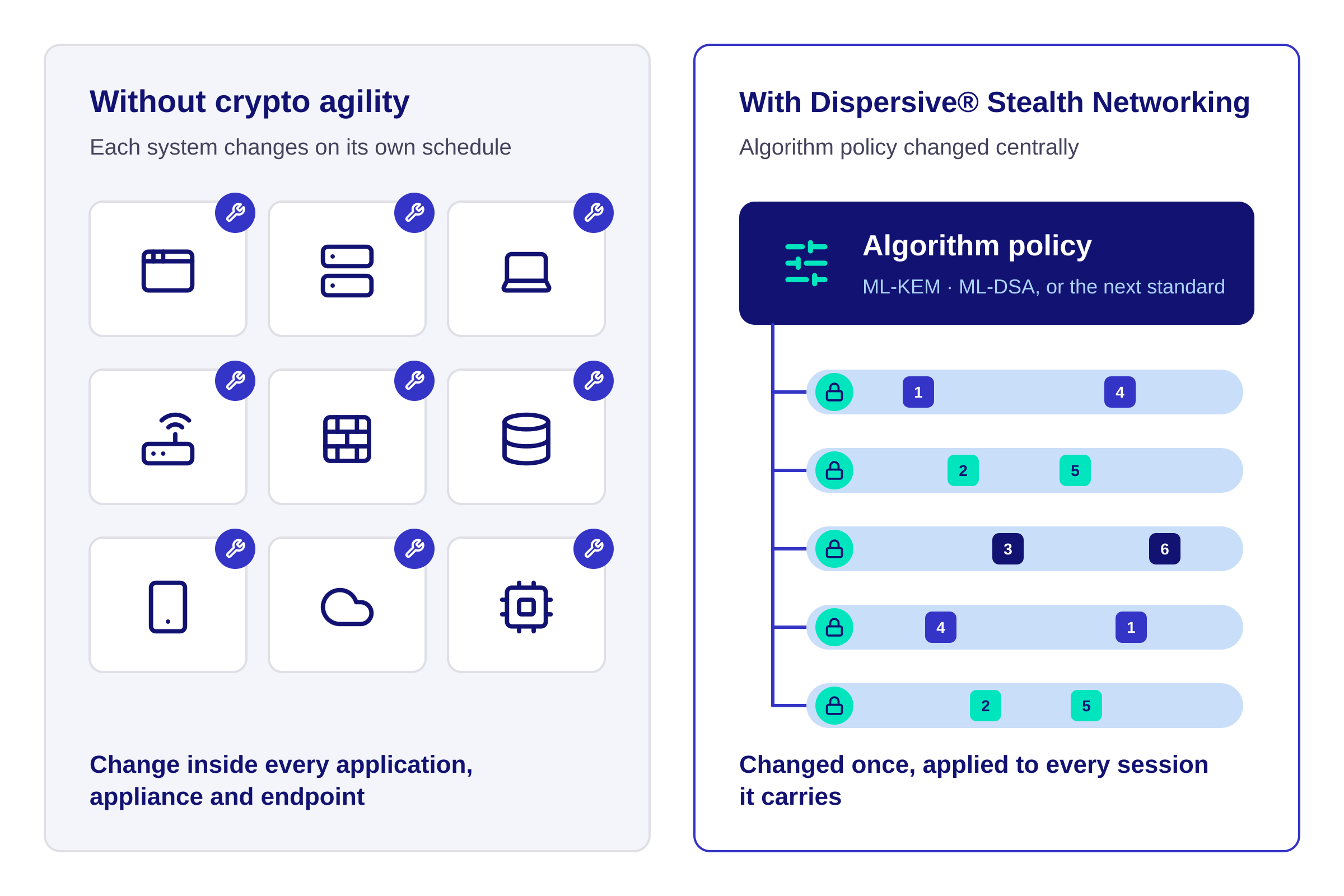
Crypto Agility in One Place
Dispersive operates at the transport layer, so algorithm policy is set centrally and applies to every session it carries. Algorithms change in one place rather than inside every application, appliance and endpoint. When a scheme is deprecated or a new standard arrives, the change is a policy update, not a re-engineering program. Crypto agility is the requirement organizations find hardest to evidence, and the one that sets the cost of every transition after this one.
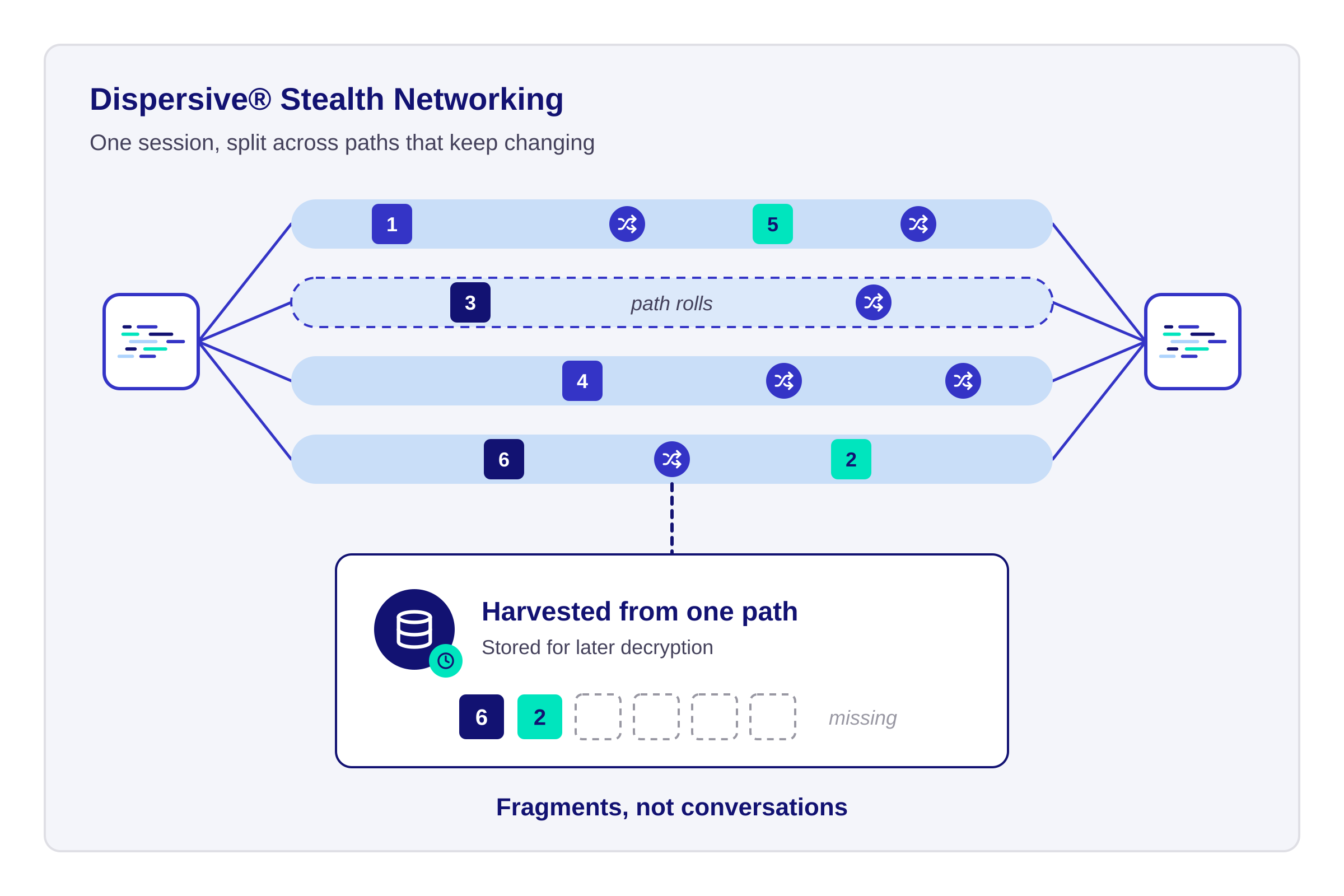
Harvest Now, Decrypt Later Mitigation
Harvest depends on capturing whole conversations. Dispersive splits each session into independently encrypted segments across paths that keep moving, using Automated Moving Target Defense. A collector on any one link captures fragments, and reassembly requires collecting across several paths at once while preserving their timing. This addresses the half of quantum risk that algorithm replacement does not reach.
What an Adversary Must Do
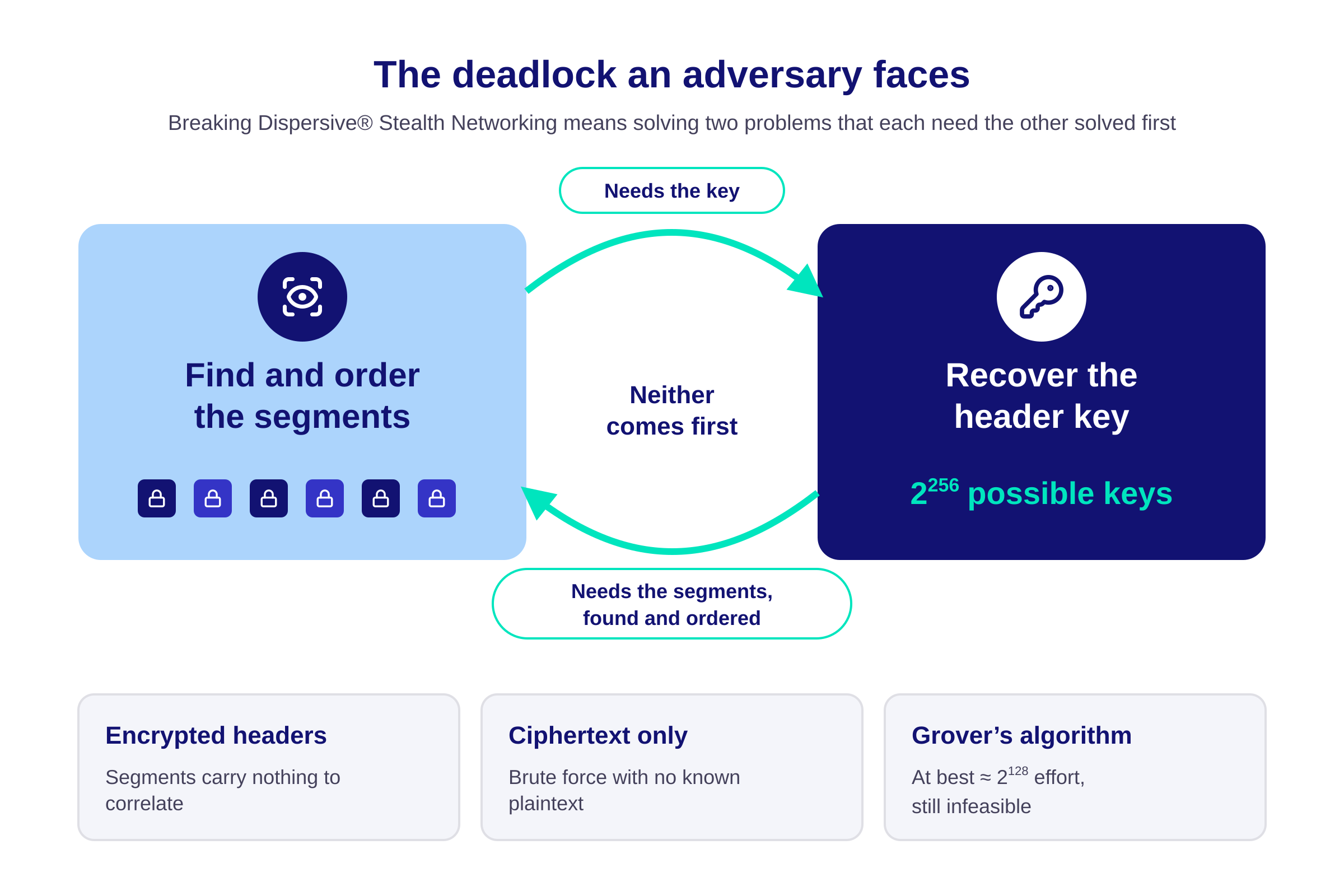
To attempt to break Dispersive, an adversary must collect every segment on every path, reconstruct the encrypted headers in the correct order, and only then attempt to recover the AES-256 header key. Identifying the right segments and their order depends on that same key, so each step requires the other. A brute-force search of the full 2256 key space at 1018 attempts per second would take roughly 3.7 × 1051 years, and Grover’s algorithm reduces the effort to about 2128 at best, which remains computationally infeasible.
Keep Data Moving During Migration
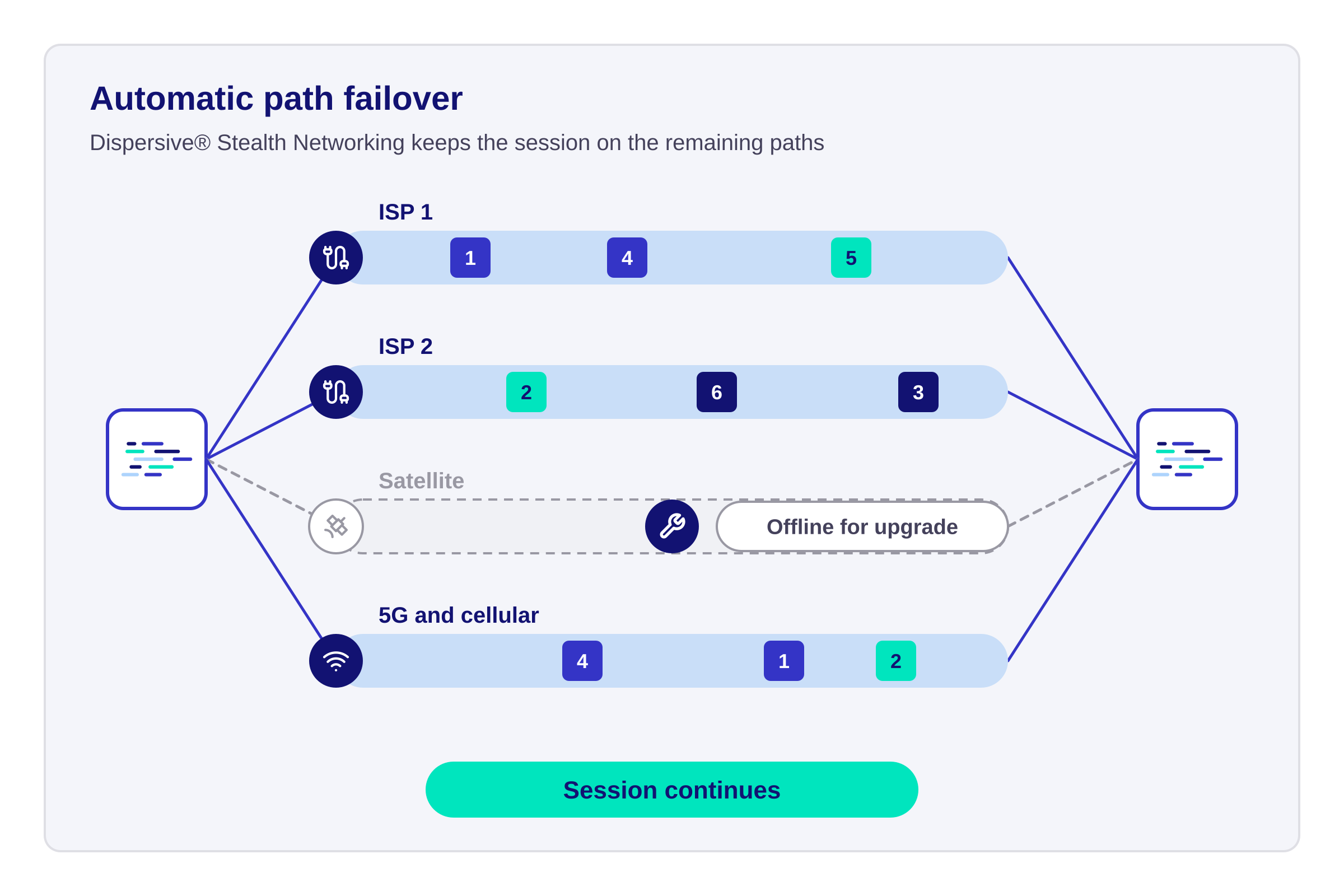
Migration happens in stages, and links go down for upgrades. Dispersive carries each session across several network paths at once, with automatic path failover, so taking one offline shifts traffic to the others. Mission threads, payments and customer services keep running while cryptography is replaced underneath them.
Meet Federal PQC Mandates: EO 14412, CNSA 2.0 and the FAR Rule
Federal policy has put hard dates on replacing cryptography, and the coming acquisition rule carries them down the supply chain. Executive Order 14412 directs the FAR Council to propose a rule carrying post-quantum obligations into federal contracts, with a proposed rule expected around December 19, 2026. An organization with no direct federal contract can inherit the requirement by selling to a company that holds one, and agencies writing migration plans are already asking vendors about cryptographic posture.
Which Federal PQC Mandates Apply to Your Organization
| If you are | What is required | Key dates |
|---|---|---|
| A federal civilian agency | Migrate high-value assets and high-impact systems to NIST-standardized PQC. Submit a migration plan, keep a cryptographic inventory and name a PQC migration lead. | Migration plans due in 2026. Key establishment by December 31, 2030. Signatures by December 31, 2031. |
| An NSS or defense program | Support the CNSA 2.0 suite in new acquisitions: AES-256 for data in transit, ML-KEM-1024 for key establishment and ML-DSA-87 for signatures, under CNSSP 15 and the DoW PQC Strategy. | New acquisitions compliant from January 1, 2027. DoW systems support PQC by December 31, 2030 and use PQC by December 31, 2031. |
| A federal prime contractor | Comply with NIST FIPS incorporating the finalized post-quantum algorithms. The obligation arrives through FAR rulemaking directed by EO 14412. | Proposed rule expected around December 19, 2026. Compliance targeted for December 31, 2030. |
| A subcontractor or supplier | The same obligations, flowed down through prime contracts. No direct federal contract is needed to inherit the requirement. | Follows the prime contract schedule, anchored on December 31, 2030. |
The Federal PQC Calendar
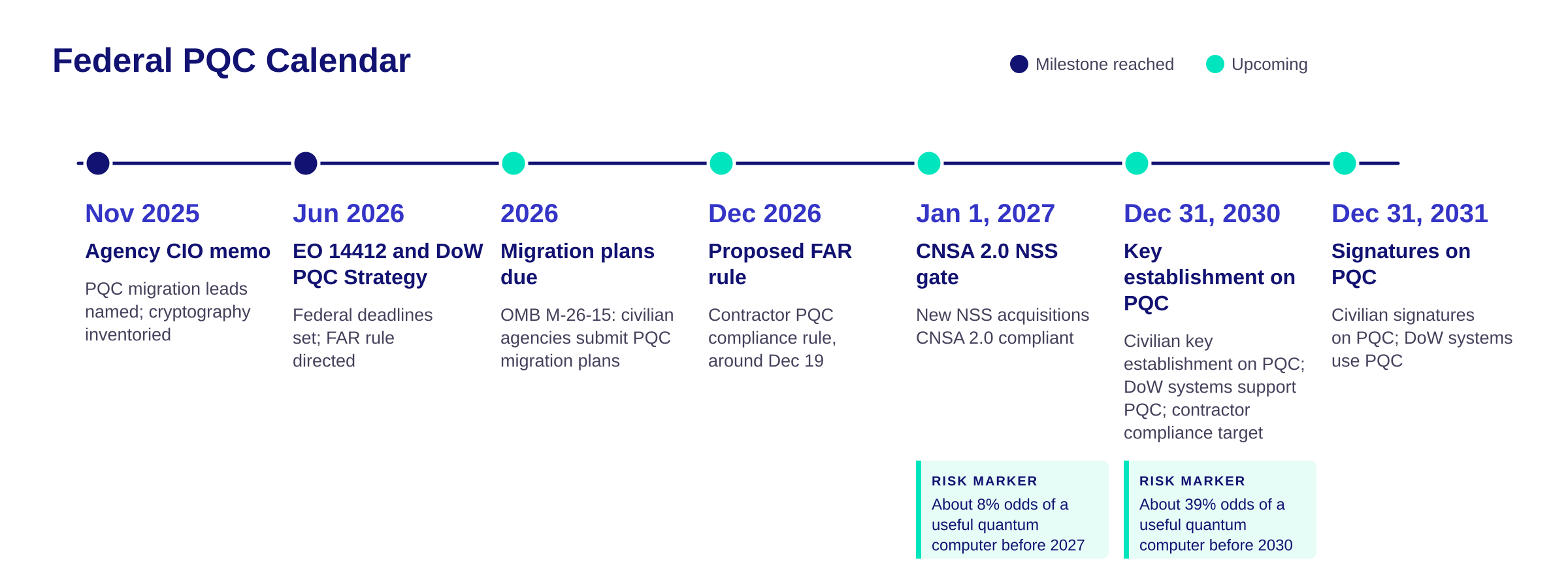
Civilian agency milestones apply to non-national security systems. National Security Systems follow the CNSA 2.0 timeline under CNSSP 15.
“Mission capability and capacity should not be sacrificed during the migration.”
Department of War Post-Quantum Cryptography Strategy, 2026
CNSA 2.0 Compliance for Data in Transit
CNSA 2.0 specifies AES-256 for data in transit, ML-KEM-1024 for key establishment and ML-DSA-87 for signatures, and new National Security System acquisitions must comply from January 1, 2027. Dispersive applies ML-KEM and ML-DSA across the data plane and control plane, with separate AES-256 keys for headers and payloads, on transport already in place. AES-256 is the symmetric algorithm specified in CNSA 2.0, so together this covers all three parts of the CNSA 2.0 core: key establishment, signatures and data transport.
How Dispersive Accelerates Federal PQC Compliance
Dispersive provides a network-layer control that supports and accelerates compliance for the communications it carries. It delivers post-quantum cryptography, crypto agility and harvest now, decrypt later mitigation without touching the endpoints, appliances or encryptors already on your migration plan. Your crypto agility requirement has a working answer rather than a plan, and the vendor readiness response we supply goes straight into your third-party coordination record.
The cryptographic module powering Dispersive services is FIPS 140-3 validated under CMVP certificate #5247, which primes and suppliers can cite directly, including in CMMC Level 2 assessments. FIPS 140-2 certificates moved to historical status in September 2026. Dispersive is ECCN 5D002 under EAR, not ITAR. Explore Federal Solutions or download the Federal PQC Mandates solution brief.
Reference to Executive Order 14412 and the DoW Post-Quantum Cryptography Strategy does not imply U.S. Government endorsement.
PQC Readiness for Financial Institutions and the Enterprise
Every enterprise faces the same quantum risk, with or without a mandate: data collected today stays exposed after migration. Financial institutions feel it first, because they hold data that must stay confidential for decades and U.S. authorities have started the clock on post-quantum readiness.
Treasury’s Financial Sector Quantum Readiness Task Force, launched in August 2026, is assessing technology vendors and third parties and promoting cryptographic agility. The Treasury-co-chaired G7 Cyber Expert Group roadmap points to 2030–2032 for the most critical financial systems, and NIST proposes deprecating RSA-2048 and ECC P-256 after 2030. The Hudson Institute estimates a single-day quantum attack on one top-five U.S. bank’s access to Fedwire would cost the U.S. economy $2.0 to $3.3 trillion in indirect impact.
Data in Motion With a Long Confidentiality Horizon
| Data in motion | Why it is a target | How long it must stay confidential |
|---|---|---|
| Customer identity and account data | Account numbers, Social Security numbers, credentials and biometrics remain usable for fraud long after they are captured. | The life of the customer relationship, and beyond |
| Payments and interbank messaging | Payment instructions, settlement and interbank messages expose counterparties, account data and the authentication that moves money. | As long as the accounts and relationships they expose remain active |
| Mortgage and lending files | Income, asset and identity records sit inside loans that run for up to 30 years. | The life of the loan, plus record retention |
| Trading, risk and M&A communications | Strategies, models and deal terms lose their value the moment someone else reads them. | Until the strategy is retired or the deal is public |
| Insurance and reinsurance flows | Policyholder and claims records, underwriting models and reinsurance treaty terms move between carriers, brokers and reinsurers. | The life of the policy, plus claims and record retention |
| Data moving to and from AI initiatives | Training data, inference calls and agent traffic carry the records above in bulk between data centers, clouds and partners. | As long as the most sensitive record it carries |
The Financial Services PQC Timeline
Regulators, standards bodies and the threat itself are setting the pace. Data harvested before these dates stays exposed after them.
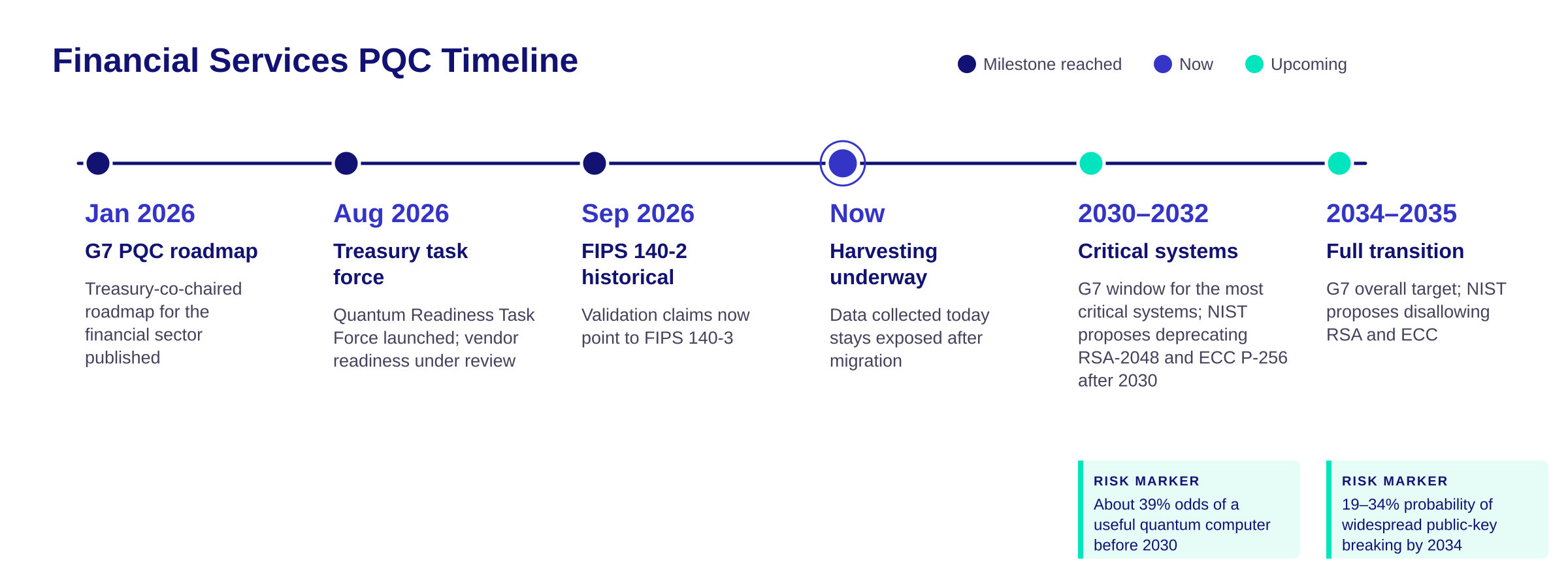
Sources: U.S. Department of the Treasury; NIST IR 8547 (initial public draft); risk markers from data cited by Citi Institute.
Citi Institute’s Recommendations, Delivered in One Deployment
| Citi Institute recommends | What Dispersive delivers |
|---|---|
| Deploy network overlays now for immediate protection against harvest now, decrypt later. | A lightweight network-layer overlay, post-quantum protected from the day it is deployed. |
| Protect all inbound and outbound data flows without changing underlying applications. | No rip and replace. Applications, endpoints and providers stay as they are. |
| Use overlays as the rapid defense while longer-term cryptographic migration proceeds. | Protection now, with your migration program running on its own schedule. |
| Start piloting early rather than waiting for inventories and strategies to finish. | Highest-consequence paths protected while the estate is still being inventoried. |
| Build crypto agility to switch algorithms quickly as threats and standards change. | Algorithms change in one place, not inside every application. |
| Hold vendors to cryptographic foundations that keep pace with client timelines. | A vendor readiness response for your third-party risk management record, the same vendor readiness Treasury’s task force is now examining. |
Start with a path-assessment pilot on one critical flow or business unit, such as payments, trading or a branch network. Explore Financial Services & Insurance or download the Financial Services PQC solution brief.
Recommendations derived from Citi Institute, Quantum Threat: The Trillion-Dollar Security Race Is On (January 2026). Reference to Citi Institute and Hudson Institute research does not imply endorsement.
Two Ways to Deploy Dispersive® Stealth Networking
Fortifying Networks with Secure, Resilient, and High-Performance Connectivity
DispersiveCloud®
DispersiveCloud® is a hosted SaaS deployment, SOC 2 Type II certified, that simplifies deployment and management without compromising performance or security. It runs on global cloud infrastructure from providers including Amazon Web Services and Azure for high availability.
DispersiveFabric™
DispersiveFabric™ is the self-hosted deployment, built for larger, more complex environments, where you run and control every component. A software-defined overlay network with a microservices architecture, DispersiveFabric™ deploys on the infrastructure you choose; public cloud, private cloud, containers, VMs, or dedicated hardware.
