


Recent headlines have shaken confidence in the technology supply chain. Questions about who controls the world's most critical chips, who may be influencing access to them, and whether the people and processes behind them can be fully trusted have moved from policy circles to the front page.
No organization can verify every link in its supply chain, including the chips, the firmware, the suppliers, and the people behind them. Organizations can't wait for every investigation to conclude before deciding how to protect their operations. The question is no longer only whom can we trust. It is what can we protect even when trust is uncertain.
As AI, quantum computing, and infrastructure-centric cyber threats converge, protecting the technology we buy is no longer enough. We must also protect the communications we depend upon, even when the underlying infrastructure has been compromised.
The global technology supply chain has become a strategic cybersecurity concern. Advanced semiconductors, artificial intelligence processors, networking equipment, embedded firmware, and communications infrastructure are now essential to virtually every major industry and national security mission.
Organizations invest considerable resources ensuring that the technologies they purchase are secure. But an increasingly important question remains: What happens when a trusted technology component, or the infrastructure connecting it to the rest of the world, is compromised?
The consequences can extend far beyond stolen information. A compromised component could potentially provide an adversary with persistent access, an opportunity to manipulate information, or a means of disrupting critical operations. In increasingly automated environments, those consequences may occur at machine speed, before human operators recognize that something is wrong. And even when the hardware itself is trustworthy, the communications networks carrying its information may not be.
The next generation of cybersecurity must assume that some of the infrastructure supporting critical operations may already be compromised.
Traditional cybersecurity architectures frequently emphasize preventing adversaries from entering protected environments. Firewalls, endpoint protection, intrusion detection, and Zero Trust controls remain essential.
However, infrastructure-centric cyber campaigns have demonstrated that sophisticated adversaries can establish persistent access within communications networks and other critical infrastructure. Such access can create opportunities to observe traffic, collect information, interfere with communications, or position an adversary for future disruptive operations.
Now consider the additional implications of compromised technology components: A malicious or compromised semiconductor, firmware component, embedded controller, or network-connected device could potentially become a foothold for an adversary. Depending on its privileges and connectivity, that foothold might enable unauthorized data collection, remote access, command execution, or manipulation of system behavior.
The challenge is particularly serious when these devices participate in critical infrastructure, military systems, industrial automation, cloud computing, or autonomous operations.
An organization may not be able to establish complete trust in every component of its technology supply chain. Nor can it assume that every communications network connecting those components is free from adversary control.
This requires a different defensive strategy.
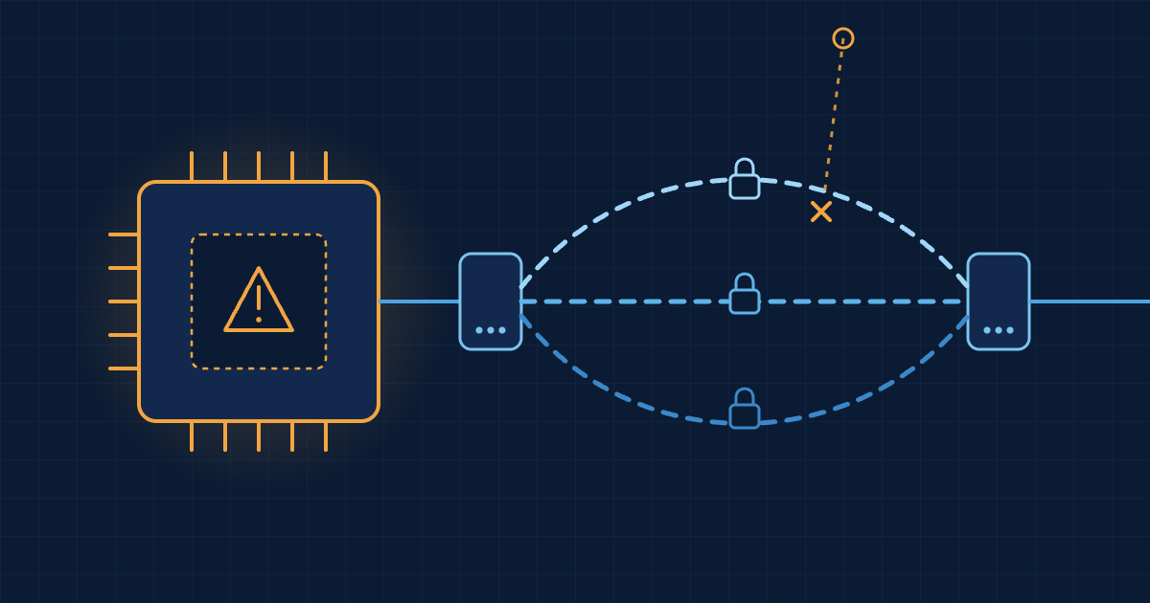
Imagine two facilities connected through a communications network. Each facility uses a Dispersive® Stealth Networking gateway, and the gateways establish a protected communications connection across the intervening infrastructure.
Now suppose an adversary compromises a device or semiconductor component within one facility's endpoint network. The compromise may create a serious local security problem. However, it does not automatically provide the adversary with the ability to intercept and understand communications traversing the protected connection between the Dispersive gateways.
Dispersive employs encrypted communications, dynamically distributed microstreams, identity-bound connectivity, and multiple transport paths to protect information moving between authorized endpoints. An adversary observing one or more intermediate network locations cannot simply collect protected microstreams and reconstruct readable information without the necessary cryptographic keys and authorized processing.
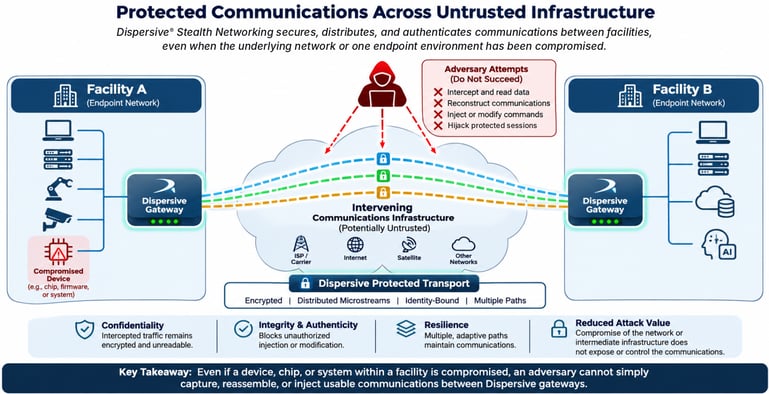
Similarly, the adversary cannot simply insert arbitrary commands into an existing authenticated Dispersive session and expect those commands to be accepted as legitimate protected traffic. This distinction is particularly important when adversaries have already compromised portions of the underlying communications infrastructure.
Compromising a network component is not equivalent to gaining control of the protected communications passing through it.
There are important security boundaries. If malicious hardware can read plaintext within the compromised facility, or can communicate over an independent, unprotected connection, it may still be capable of exfiltration or remote command-and-control. Dispersive does not automatically neutralize malicious chips, compromised endpoints, or unauthorized communications that bypass its protected transport.
However, the adversary cannot assume that compromising a network component, intercepting protected traffic, or gaining visibility into an intermediate communications path provides access to the information carried inside Dispersive's authenticated and encrypted transport. This creates an additional defensive boundary between the security of the underlying infrastructure and the security of mission-critical communications.
Artificial intelligence is already changing cybersecurity by accelerating activities such as vulnerability discovery, malicious code development, reconnaissance, and attack adaptation. As agentic AI and machine-to-machine communications become more common, organizations will increasingly depend on systems that exchange information, make decisions, and execute actions without continuous human intervention.
This creates a new operational challenge. An adversary may not need to shut down an entire network. Delaying critical information, interrupting a machine-to-machine connection, or manipulating data before it reaches a decision system may be sufficient to cause serious operational consequences.
The traditional military Observe–Orient–Decide–Act, or OODA, Loop provides a useful analogy. When critical observations are unavailable, delayed, or unreliable, the quality and timeliness of subsequent decisions can deteriorate. For autonomous and AI-enabled systems, those decision cycles may occur in milliseconds. Consequently, cybersecurity must increasingly protect not only confidentiality but also communications integrity, availability, resilience, and continuity.
Dispersive addresses these requirements through a a hardened transport architecture designed to protect communications across untrusted and potentially compromised networks. It does not independently determine whether an AI-generated conclusion is correct or whether information was falsified before entering the protected channel. Those risks require complementary data-integrity, endpoint-security, and AI-assurance controls. Nevertheless, trustworthy decisions depend in part on secure and reliable delivery of the information supporting them.
While AI is already accelerating cyber threats, quantum computing introduces a different concern. Future cryptographically-relevant quantum computers could undermine widely deployed public-key cryptographic mechanisms. Adversaries may also collect encrypted communications today in anticipation of decrypting them when suitable quantum capabilities become available. This is the harvest-now, decrypt-later threat. Organizations protecting sensitive information with long confidentiality lifetimes cannot afford to wait until a sufficiently powerful quantum computer exists.
Dispersive incorporates post-quantum key establishment using ML-KEM-1024, complementing its AES256-encrypted, multipath communications architecture. However, Post-quantum cryptography does not make a system immune to every quantum-related or AI-enabled threat. This is one reason why Dispersive employs segmentation, dynamic paths, and per-channel per-session encryption. Organizations must still evaluate their complete cryptographic dependencies, endpoint security, authentication mechanisms, and implementation configurations.
But the convergence of AI-driven cyber operations and future quantum capabilities reinforces an important principle: Communications security must be designed for the threats of tomorrow, not merely the attacks of yesterday.
Organizations do not have to wait for the next supply chain compromise or infrastructure attack to strengthen their defenses.
Determine which communications among facilities, cloud environments, employees, devices, AI agents, and automated systems are essential to maintaining operations.
Protect critical communications independently of the trustworthiness of intermediate routers, service providers, and network segments.
Where operationally appropriate, employ path diversity, adaptive transport, and resilient connectivity to reduce the consequences of disruption or compromise.
Validate hardware and firmware provenance, maintain secure configurations, restrict unauthorized outbound communications, monitor endpoints, and apply least-privilege access controls.
Identify vulnerable cryptographic dependencies, prioritize information requiring long-term confidentiality, and adopt appropriately validated, standards-based post-quantum solutions.
Evaluate technologies that combine encryption, authenticated connectivity, traffic camouflage, and resilient multipath transport to protect communications even when the underlying network cannot be fully trusted.
These measures are complementary. No single product can eliminate every supply chain, endpoint, infrastructure, AI, or quantum threat.
The growing importance of semiconductors, AI processors, autonomous systems, and interconnected infrastructure creates enormous opportunities. It also expands the consequences of technology compromise. Organizations must continue protecting the components they purchase and the systems they operate. But they must also recognize that even carefully secured environments depend on communications infrastructure outside their direct control.
Dispersive® Stealth Networking addresses this challenge through an approach that combines encrypted communications, identity-bound connectivity, traffic camouflage, dynamic multipath transport, and post-quantum key establishment. Rather than requiring every intermediate network component to be trustworthy, Dispersive is designed to preserve protected communications across infrastructure that may be unreliable, monitored, or compromised.
The objective is not to claim that compromise can never occur. It is to make the compromise of an underlying communications path substantially less useful to an adversary while helping critical operations remain connected. In an era of uncertain supply chains, AI-accelerated attacks, infrastructure compromise, and emerging quantum threats, protecting the network is no longer enough. We must protect the communications on which the mission depends.
Dispersive Denies the Adversary's Battlefield Advantage.
Dispersive helps federal agencies and mission partners keep critical communications protected, even when the supply chain and the underlying network cannot be fully trusted. Deployed as a lightweight overlay on your existing network, it adds a protected communications layer without replacing the infrastructure you already run. Request a demo to see how it fits your mission.

